
How to Train AI to Speak Like Your Business Brand Voice
In today’s AI-driven world, businesses face a critical challenge: how to make AI-generated content truly reflect their unique brand voice. Using generic AI templates risks sounding bland and disconnected from what makes your business special. Training AI to speak like your business isn’t just a nice-to-have—it’s essential for building trust, consistency, and standing out in competitive markets Chapman Graduate School, 2023.
But how exactly do you train AI to sound like your business? It goes far beyond plugging in a chatbot or content generator. It demands a clear strategy involving data management, model training, prompt engineering, and ongoing human oversight. Each step shapes how well the AI captures your tone, style, and values Tarafdar et al., 2020.
This article breaks down the key steps and best practices to customize AI for your brand voice. You’ll learn about the technical foundations, the art of prompt engineering, the importance of human-AI collaboration, and strategic choices about building or buying AI tools. By the end, you’ll know how to make AI work for your business—speaking with your voice, not a generic one.
What Are the Technical Foundations for Training AI to Match Your Brand Voice?
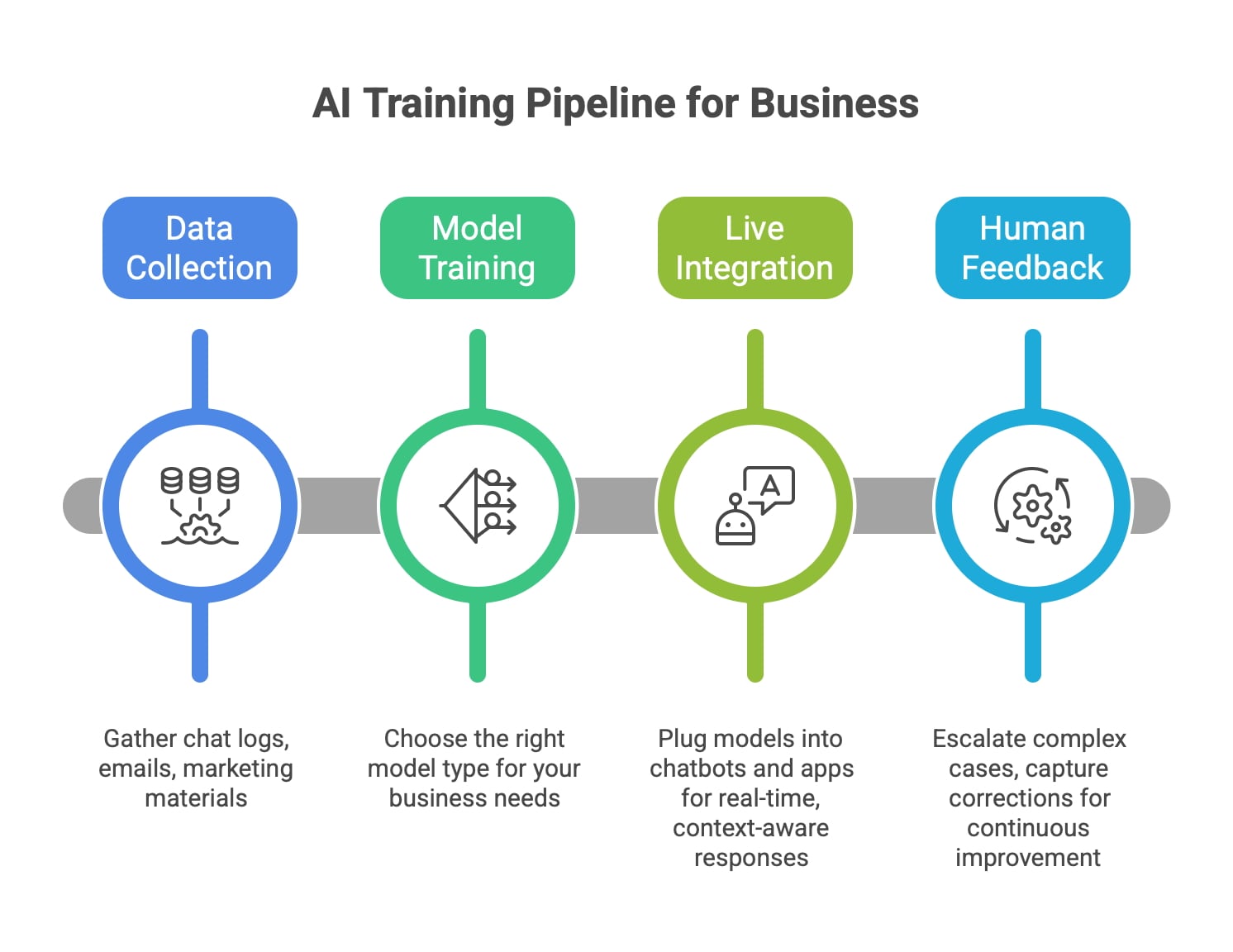
Training AI to sound like your business starts with a solid technical pipeline that turns your data into customer-facing content. This pipeline has four main stages:
Data Ingestion and Management
First, collect high-quality data that reflects your brand’s communication style. This can include chat logs, emails, transaction records, and marketing materials. Remember: AI quality depends on data quality. Poor or inconsistent data leads to generic or off-brand outputs Chapman Graduate School, 2023.
Data governance is also key. You must handle customer data responsibly, respecting privacy and consent. If data is missing or unapproved, your AI should default to generic responses to stay compliant Chapman Graduate School, 2023.
Model Training and Selection
Next, choose AI models that fit your business needs. For simple tasks like identifying customer intent, classification models work well. For generating brand-aligned text, transformer-based or generative models are better. These models are trained on your curated data and tested for accuracy and fairness before use Tarafdar et al., 2020.
The model you pick affects not only performance but how well it can replicate your unique voice.
Inference and Orchestration
Once trained, models are integrated into applications like chatbots or email generators. This stage delivers real-time, context-aware responses that customers see. Ensuring models are trained on brand-specific data here is crucial—this is where your AI’s voice becomes visible Tarafdar et al., 2020.
Human-in-the-Loop Feedback
AI can’t nail your brand voice perfectly on its own. Human oversight is essential. Complex or risky cases should be escalated to human agents, and their corrections fed back into the system. This ongoing feedback loop refines AI outputs and keeps them aligned with evolving business needs Tarafdar et al., 2020.
How Does Prompt Engineering Help Shape AI to Your Brand’s Style?
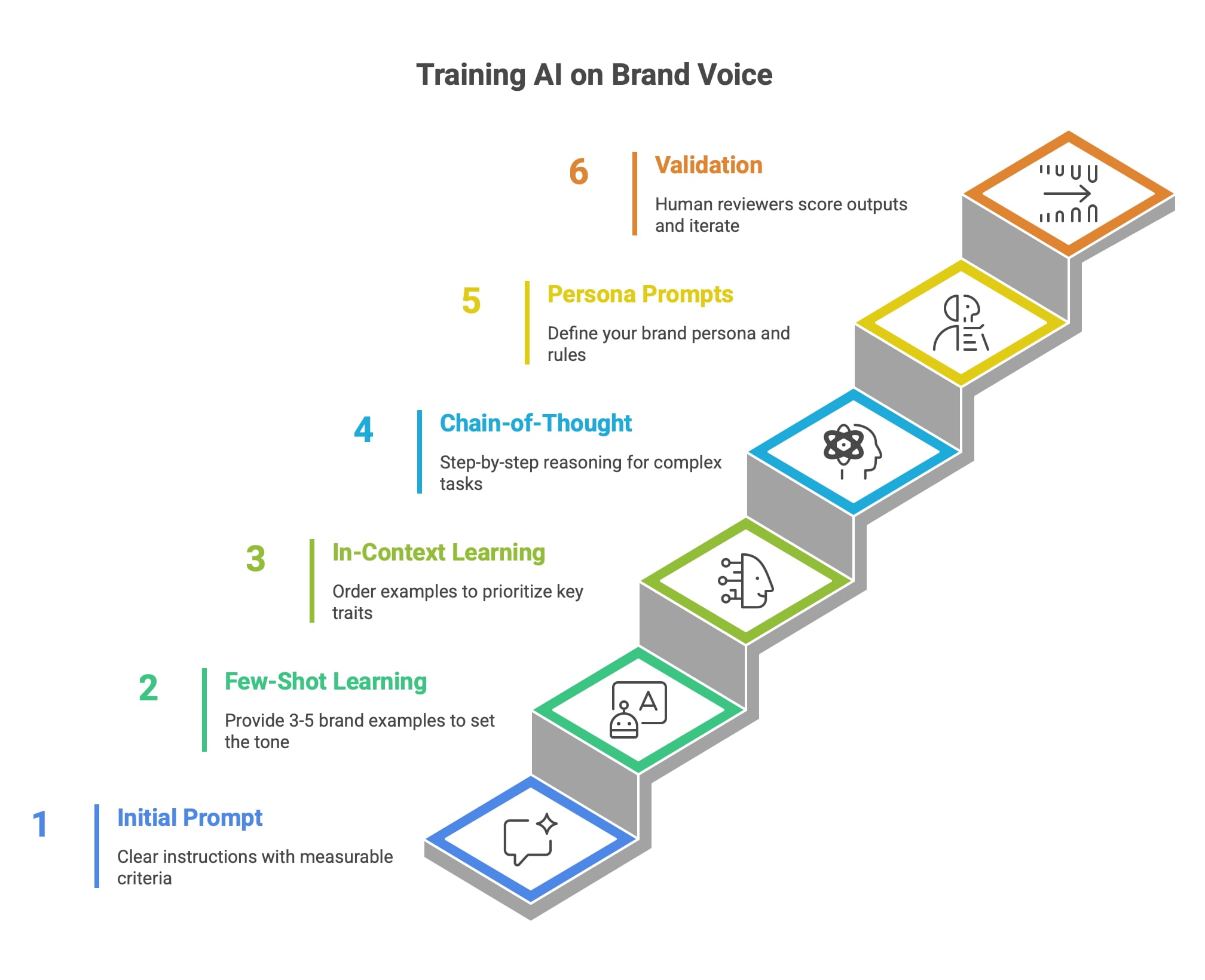
Prompt engineering is the practice of crafting specific instructions and examples that guide AI to generate content matching your brand’s tone and style. It’s a crucial step after model training.
The Prompt Engineering Process
Start with a clear initial prompt, such as “Write a customer support reply in our friendly, professional tone.” Define measurable criteria like clarity and brand consistency. Then, review AI outputs and refine prompts iteratively until the AI consistently produces the desired style Shah, 2025.
Few-Shot and In-Context Learning
Provide the AI with a few examples of your business’s writing. These samples help it learn your brand’s vocabulary, sentence structure, and tone. Testing different example orders can further improve results Prompting Guide, 2025.
Chain-of-Thought and Persona Prompts
For complex tasks, chain-of-thought prompting encourages AI to reason step-by-step, reflecting how your business approaches problems. Persona prompts set a consistent voice across sessions by instructing the AI to “act like” your brand Schulhoff et al., 2024.
Validation and Iteration
Prompt engineering requires rigorous review. If reviewers disagree on whether outputs match your brand, adjust your evaluation criteria and refine prompts. This human-in-the-loop process ensures consistency and removes bias Shah, 2025.
Limitations and Best Practices
Prompt engineering can’t guarantee factual accuracy or prevent AI hallucinations (false information). For critical content, augment prompts with external data or verification. Also, keep in mind that prompt engineering demands time and documentation, so balance rigor with your resources Shah, 2025.
How Can Human-AI Workflows Protect Your Brand Voice?
Even the best AI needs human collaboration to maintain authenticity and brand integrity. Human-AI workflows balance automation efficiency with human judgment.
Task Classification and Boundaries
Classify tasks by complexity and risk. Let AI handle repetitive, high-volume jobs like drafting initial replies or summarizing feedback. Reserve human control for tasks involving legal, regulatory, or reputational risk Corb et al., 2023.
Context Engineering and Data Preparation
AI performs best with curated, verified data. If data is incomplete or unverified, humans must validate before automation proceeds Glean, 2025.
Agent Orchestration and Oversight
Deploy specialized AI agents for different subtasks, such as research or drafting. Orchestration manages handoffs between AI and humans, ensuring outputs are accurate, original, and compliant before release Glean, 2025.
Verification and Decision-Making
Humans review AI-generated content, confirming it aligns with brand values and regulatory standards. This is vital for public-facing content where errors can damage reputation or cause legal issues Corb et al., 2023.
What Strategic Choices Should I Make: Build, Buy, or Integrate AI?
Choosing how to implement AI that reflects your brand voice requires a strategic approach. The main options are building a custom solution, buying a vendor product, or integrating external tools with your systems.
Define Your Business Problem
Clarify what you want AI to do. Are you automating content creation, personalizing customer interactions, or supporting sales? If your brand voice is a key differentiator, building a custom AI may be best GP Strategies Corporation, 2026.
Assess Your Capabilities and Constraints
Consider your team’s AI expertise, engineering resources, and data maturity. If you lack skills or need quick deployment, buying a vendor solution might be practical. But vendor tools may not capture your brand’s nuances and can be costly at scale Quagliotti, 2024.
Evaluate Costs, Security, and Data Governance
Review total costs, including upfront and ongoing fees. Data privacy and proprietary data control are critical. Sensitive applications may require building or hosting AI in secure environments GP Strategies Corporation, 2026.
Consider Hybrid and Iterative Approaches
A hybrid strategy often works best: start with a vendor product to test value, then gradually add custom modules. Modular integration reduces vendor lock-in and allows flexibility Quagliotti, 2024.
Avoid Common Pitfalls
Relying on vendor solutions for core brand voice functions can erode differentiation and increase costs. Over-customizing vendor platforms without expertise can cause complexity and security issues. Ignoring scale and governance risks undermines AI success Quagliotti, 2024.
How Do I Keep AI Authentic and Effective Over Time?
Training AI to sound like your business is not a one-time project. It requires ongoing investment in data quality, prompt engineering, human oversight, and strategic planning.
- Maintain and update your data to reflect current brand messaging and customer interactions.
- Continuously refine prompts based on feedback and changing business needs.
- Keep human-in-the-loop workflows active to catch errors and evolve AI outputs.
- Reassess your build, buy, or integrate strategy as your capabilities and market demands shift.
This commitment ensures your AI amplifies your brand voice consistently, builds trust, and drives business results.
Training AI to sound like your business is a complex but achievable goal. By combining strong technical foundations, expert prompt engineering, human collaboration, and strategic decision-making, you can create AI systems that truly reflect your brand’s personality. This approach transforms AI from a generic tool into a powerful extension of your business voice—helping you connect authentically with your customers every time.
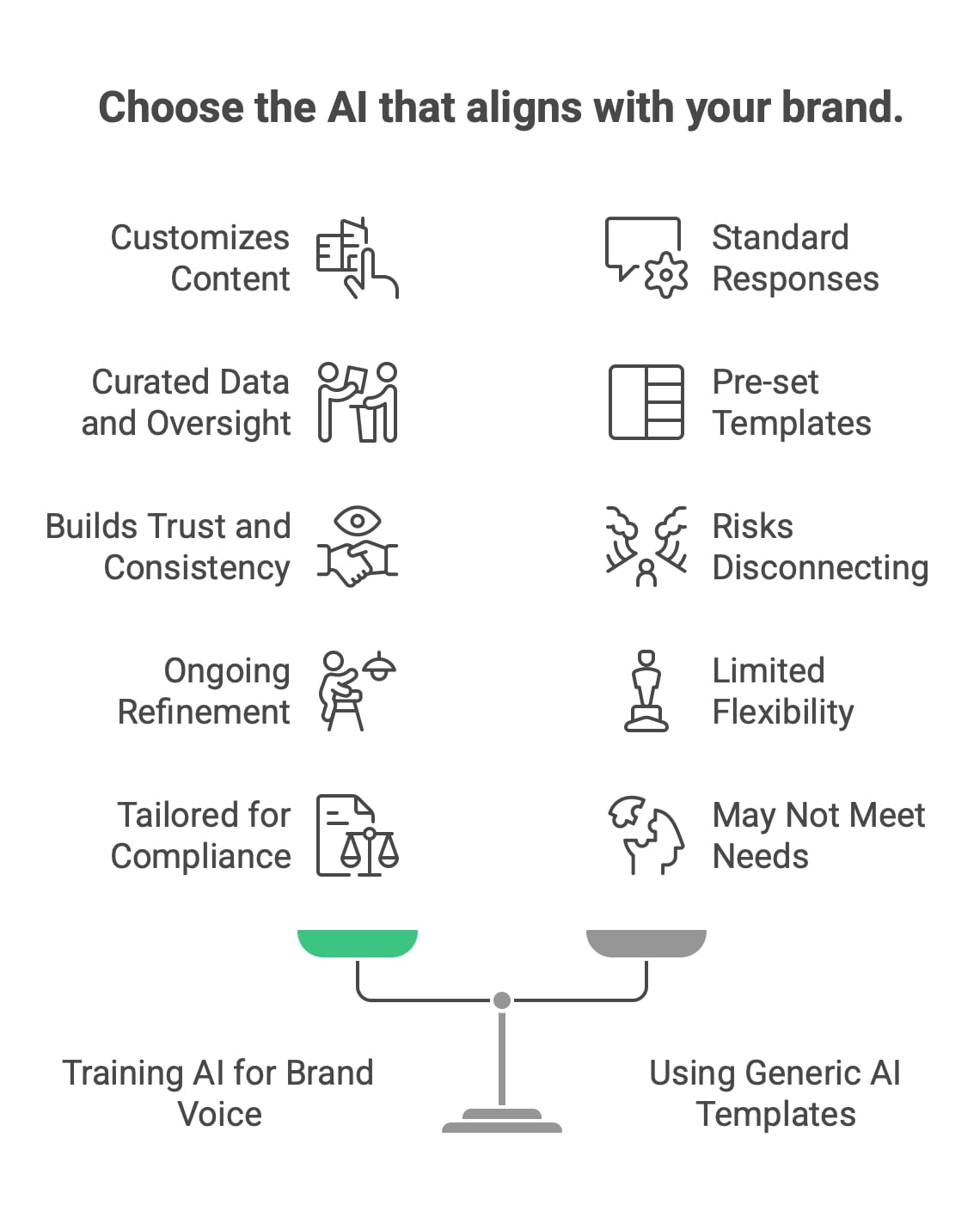
| Training AI for Brand Voice | Using Generic AI Templates |
|---|---|
| Customizes content to match your unique tone and style | Produces standard, often bland responses |
| Requires curated data, prompt engineering, and human oversight | Relies on pre-set templates with minimal adjustment |
| Builds trust and consistency with your audience | Risks disconnecting from your brand identity |
| Involves ongoing refinement and feedback loops | Offers limited flexibility and adaptability |
| Can be tailored for compliance and data governance | May not meet specific security or regulatory needs |
Frequently Asked Questions
How can I make AI-generated content reflect my business’s unique voice?
Start by collecting high-quality data that represents your brand’s communication style, then train AI models on this data and use prompt engineering techniques to guide tone and style, with ongoing human review to ensure consistency.
What is prompt engineering and why is it important for my brand?
Prompt engineering means designing clear instructions and examples that help AI generate content in your business’s specific tone, ensuring outputs are consistent and aligned with your brand.
Can I just buy an AI tool to match my brand’s voice, or do I need a custom solution?
Buying a vendor tool is faster, but it may not fully capture your brand’s nuances; building a custom AI or using a hybrid approach often delivers better results for businesses where voice is a key differentiator.
How does human oversight improve the quality of AI-generated content?
Human oversight ensures that complex or sensitive outputs are accurate, on-brand, and compliant, with human corrections fed back into the AI system for continuous improvement.
Is it enough to train AI once, or does it need ongoing updates?
AI needs regular updates to its data, prompts, and workflows to stay aligned with your evolving brand messaging and business needs.