
How RAG and Custom AI Knowledge Bases Personalize Business Operations
How Does RAG Work to Enhance Business AI?
Retrieval-Augmented Generation (RAG) is an AI architecture that combines a pre-trained large language model (LLM) with real-time retrieval of relevant information from a curated knowledge base or vector store. Unlike traditional AI models that rely solely on their fixed training data, RAG dynamically fetches up-to-date, domain-specific content at query time. This approach ensures that AI responses are accurate, current, and tailored to the specific context of the question Monte Carlo Data, 2025.
The RAG process begins by converting both the user’s query and documents in the knowledge base into embeddings—mathematical vectors that capture the meaning of the text. Then, a semantic search identifies the most relevant snippets by comparing these embeddings. These retrieved pieces of information are combined with the user’s query and fed into the LLM, which generates a response grounded in the latest and most relevant data Monte Carlo Data, 2025.
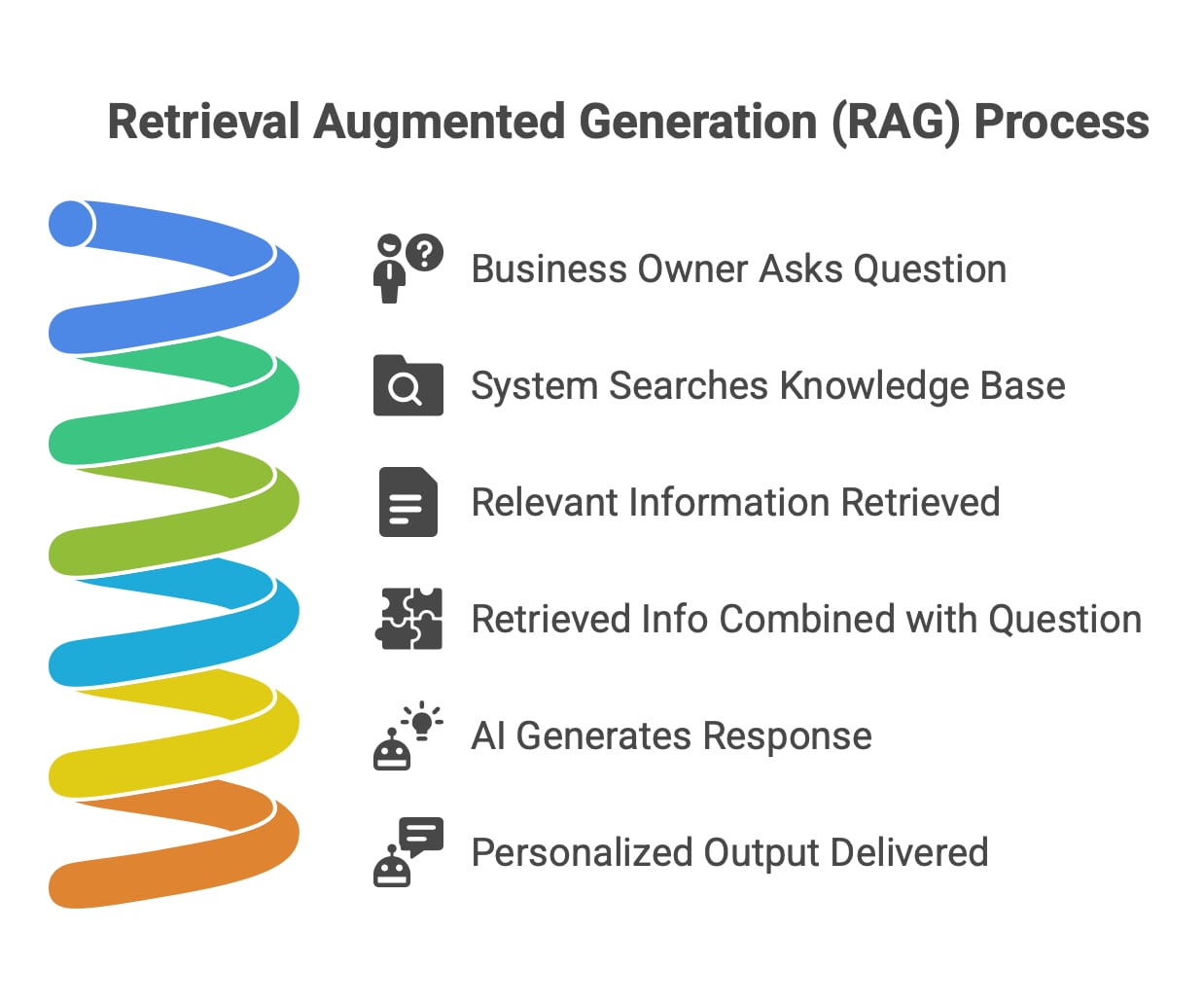
This architecture offers several advantages for businesses:
- Up-to-date knowledge: Companies can refresh their knowledge bases independently of the AI model, avoiding costly retraining when product details, policies, or regulations change.
- Traceability: Because responses link directly to source documents, businesses can provide citations and ensure compliance with audit requirements, crucial in regulated sectors like finance, healthcare, and law Murúa, 2025.
- Context awareness: RAG’s ability to retrieve context-specific data leads to more relevant and personalized AI outputs.
However, implementing RAG requires managing a retrieval infrastructure, including data ingestion, embedding generation, vector indexing, and document chunking. While this adds engineering complexity and may increase query latency, it eliminates the need for frequent retraining and enables near-instant updates to the knowledge base Monte Carlo Data, 2025.
Why Are Custom AI Knowledge Bases Essential for Personalization?
The real power of RAG lies in its integration with custom AI knowledge bases—collections of carefully curated, domain-specific information unique to each business. These knowledge bases might include internal documents, product catalogs, customer histories, compliance rules, and more. By tapping into these tailored repositories, RAG systems deliver outputs that are not only accurate but also deeply personalized to the company’s context and customer needs Monte Carlo Data, 2025.
Personalization drives business value by improving customer engagement and operational efficiency. For example:
- E-commerce platforms can use RAG to understand natural language queries and recommend products based on purchase history and inventory.
- Customer support chatbots can access the latest FAQs and policy updates to provide timely, accurate assistance Monte Carlo Data, 2025.
- AI systems analyze behavioral data and transaction histories to tailor content and offers, boosting cross-selling and upselling Chapman Graduate School, 2023.
Key Components of AI Personalization Pipelines
- Data ingestion and management: Collecting and organizing structured and unstructured customer data, such as chat logs and transaction records.
- Model training and selection: Choosing or fine-tuning AI models to best interpret and respond to queries.
- Inference and orchestration: Delivering AI-generated outputs in real time within business workflows.
- Human-in-the-loop feedback: Allowing human agents to intervene and improve AI responses based on real-world interactions Tarafdar et al., 2020.
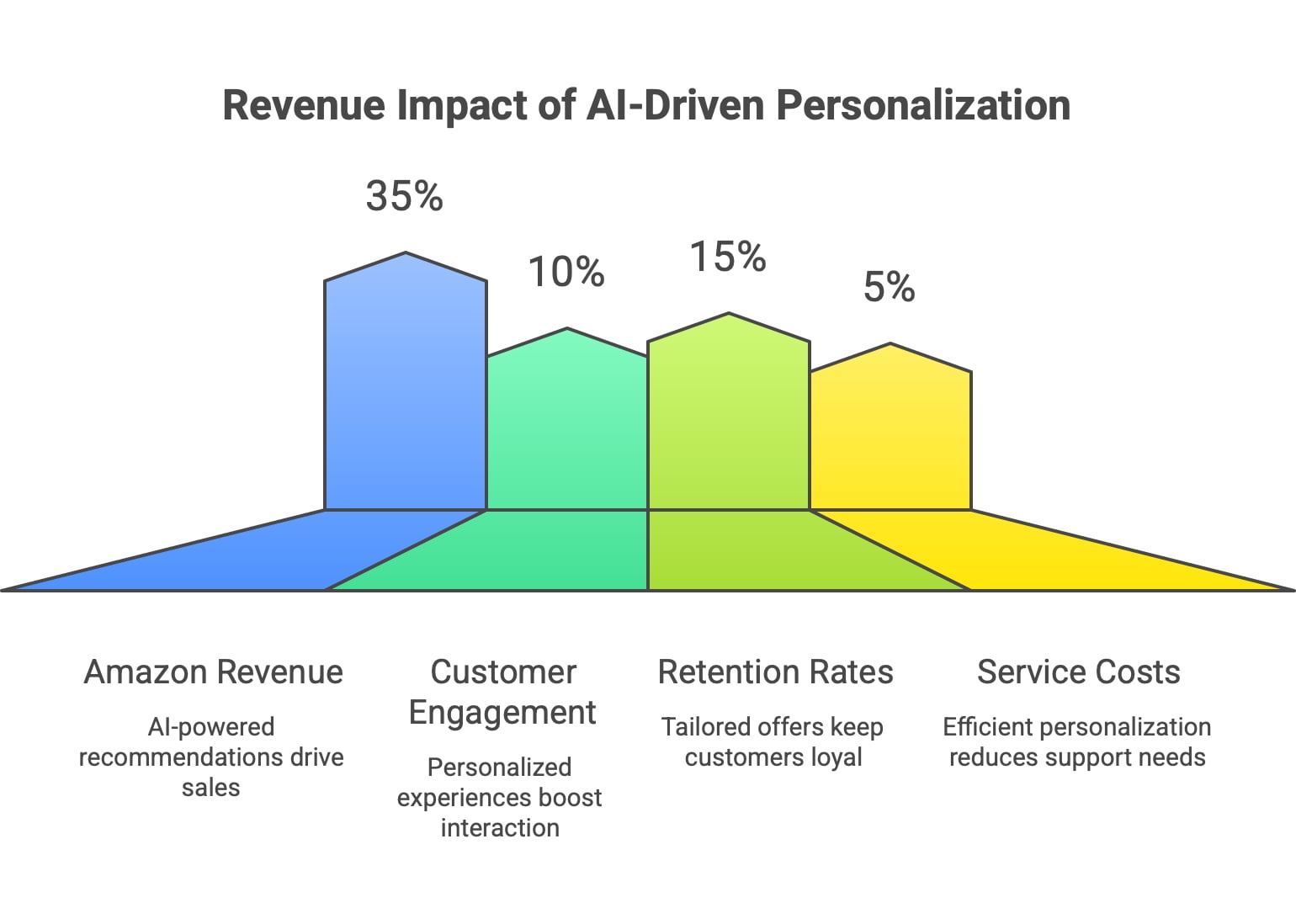
Personalization powered by RAG and custom knowledge bases leads to measurable benefits. For instance, AI-driven recommendations have been reported to generate up to 35% of Amazon’s revenue Chapman Graduate School, 2023. Additionally, personalized AI improves customer satisfaction, retention, and reduces service costs Fiedler et al., 2025.
However, success depends on:
- The quality and governance of the knowledge base.
- Seamless integration of AI into operational workflows.
- Continuous feedback and improvement loops.
- Respecting privacy and compliance to maintain customer trust Chaturvedi & Verma, 2022.
What Operational Trade-offs and Challenges Does RAG Present?
While RAG offers clear benefits, businesses must carefully manage its operational and technical complexities.
Engineering Complexity and Latency
Building a RAG system involves:
- Creating ingestion pipelines to update the knowledge base.
- Generating embeddings for documents and queries.
- Indexing documents in vector databases for fast retrieval.
- Chunking long documents and reranking snippets for relevance.
This infrastructure increases engineering overhead and can slow down response times, especially as the knowledge base grows Monte Carlo Data, 2025.
Context Window Limitations
Because LLMs have a limit on how much text they can process at once (the context window), all retrieved information plus the user query must fit within this space. This requires careful chunking and ranking of documents. Poor chunking may omit important details, leading to incomplete or unsatisfactory answers Monte Carlo Data, 2025.
Maintenance and Monitoring
RAG reduces the need for expensive model retraining but demands ongoing maintenance of:
- Knowledge base freshness.
- Retrieval quality.
- Indexing accuracy.
Organizations must invest in observability tools and data governance to keep the system reliable and auditable Altus, 2024.
Security and Compliance
Since RAG exposes external documents during retrieval, robust document-level security and access controls are essential to prevent sensitive data leaks. Proper governance ensures regulatory requirements for traceability and source attribution are met Monte Carlo Data, 2025, Murúa, 2025.
Hybrid Systems Complexity
Some organizations combine RAG with fine-tuning to leverage the strengths of both. While this hybrid approach offers internalized behavior control plus dynamic grounding, it also inherits the complexity and maintenance challenges of both methods. Such systems are best suited for high-value, high-risk applications Monte Carlo Data, 2025.
Common Pitfalls
- Underestimating the need for data governance.
- Neglecting retrieval quality monitoring.
- Failing to manage organizational change and train users properly Altus, 2024.
How Can Businesses Successfully Implement RAG for Personalization?
To unlock RAG’s full potential, organizations should adopt best practices spanning technical, operational, and organizational domains.
Prioritize Knowledge Base Quality and Governance
- Curate and regularly update domain-specific knowledge bases.
- Define clear ownership and stewardship roles.
- Implement data lineage tracking and semantic consistency checks.
- Conduct regular audits to prevent outdated or inconsistent information Databricks, 2024.
Integrate AI Seamlessly into Workflows
Embed RAG-powered AI into applications like customer support, sales tools, and decision dashboards. This ensures that AI insights are actionable and complement human workflows Tarafdar et al., 2020.
Maintain Continuous Personalization and Compliance
- Use behavioral data and real-time context to tailor AI responses.
- Balance personalization with privacy by implementing opt-in controls and clear privacy assurances Chaturvedi & Verma, 2022.
Monitor and Improve Continuously
- Track retrieval quality, user engagement, and business outcomes.
- Use feedback loops and human-in-the-loop escalation to refine AI performance Monte Carlo Data, 2025, Tarafdar et al., 2020.
Invest in Change Management and Training
- Redesign workflows to incorporate AI effectively.
- Train staff on new tools and processes.
- Establish clear metrics and accountability for AI-driven outcomes Chapman Graduate School, 2023.
Why Is RAG a Game-Changer for Business Personalization?
RAG is transforming how businesses use AI by enabling:
- Accurate, timely, and personalized AI responses grounded in current, domain-specific knowledge Monte Carlo Data, 2025.
- Cost-effective scalability through decoupling knowledge updates from expensive model retraining.
- Compliance and auditability via traceable source attribution Murúa, 2025.
By investing in custom AI knowledge bases, robust data governance, and integrated workflows, companies in Canada, Mexico, and Costa Rica can unlock new efficiencies, improve customer satisfaction, and gain competitive advantages Fiedler et al., 2025.
RAG is not a magic solution but a powerful enabler. When thoughtfully implemented, it reshapes how businesses personalize their operations and meet evolving customer expectations. The journey requires continuous learning, adaptation, and investment in both technology and people Monte Carlo Data, 2025.

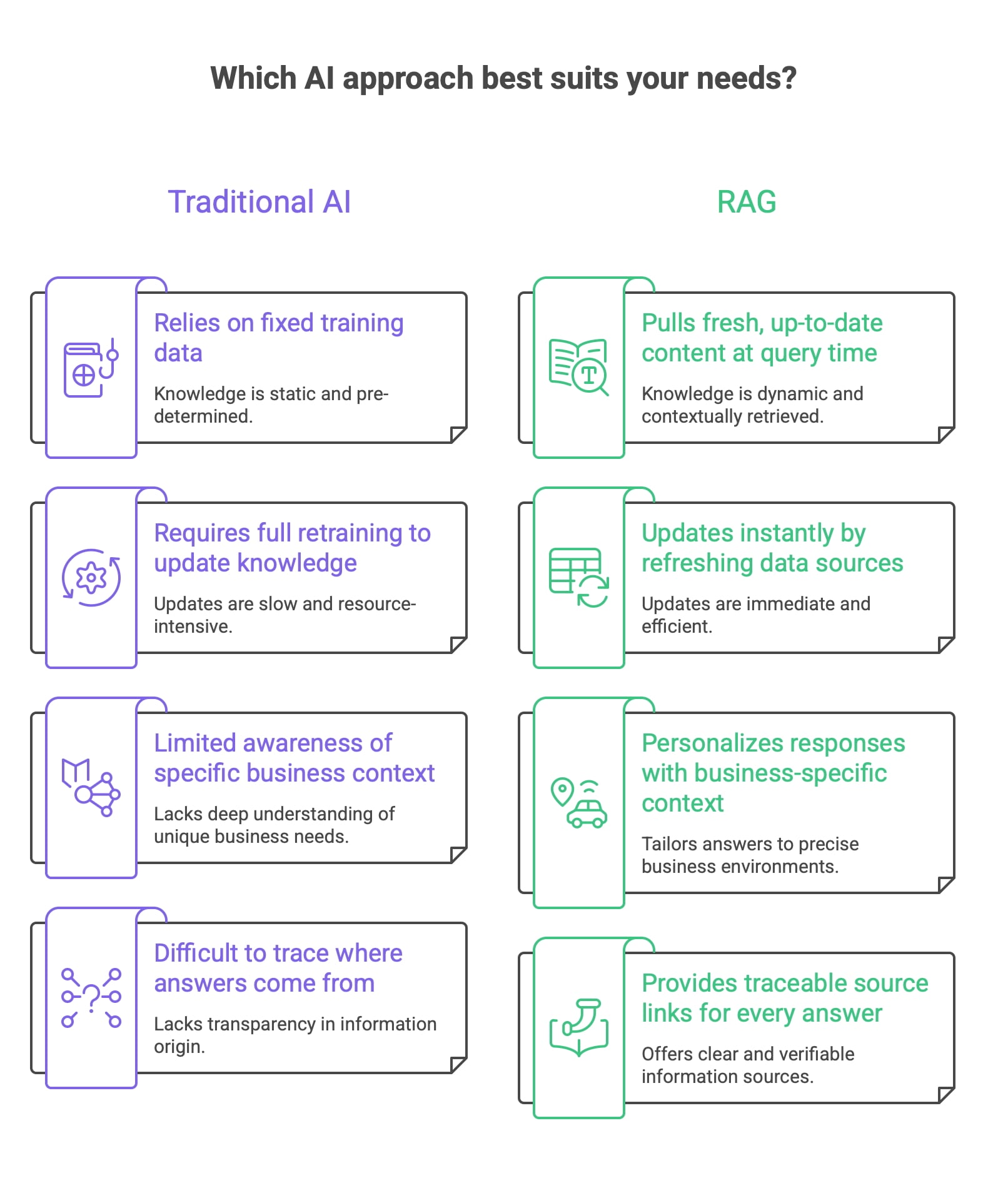
| Traditional AI Models | RAG (Retrieval-Augmented Generation) |
|---|---|
| Relies solely on fixed training data | Dynamically fetches up-to-date, domain-specific content at query time |
| Requires costly and time-consuming retraining for updates | Allows instant updates by refreshing data sources without retraining |
| Limited context awareness and personalization | Delivers responses tailored to specific business context and customer needs |
| Harder to trace and audit responses | Provides direct links to source documents for compliance and traceability |
| Less adaptable to changing regulations or product details | Easily adapts to new information, regulations, and business changes |
Frequently Asked Questions
What is RAG and how does it improve business AI?
RAG, or Retrieval-Augmented Generation, is an AI approach that combines large language models with real-time retrieval of relevant information, ensuring responses are accurate, current, and tailored to the specific business context.
How do custom AI knowledge bases help personalize customer experiences?
Custom AI knowledge bases allow businesses to use their own curated information, enabling AI to provide highly personalized recommendations, support, and offers based on individual customer needs and business data.
What are the main challenges when implementing RAG in a business setting?
Implementing RAG involves managing complex retrieval infrastructure, maintaining data quality, monitoring retrieval accuracy, and ensuring proper security and compliance controls.
Can RAG systems be updated without retraining the entire AI model?
Yes, RAG systems can be updated instantly by refreshing the data sources, eliminating the need for expensive and time-consuming retraining of the AI model.
Is it true that RAG is only useful for large enterprises?
No, RAG can benefit small and mid-size businesses by improving operational efficiency, customer satisfaction, and compliance, especially when integrated with custom data and workflows.