How to Boost Your Website’s Search Visibility and Get Found
If you’re wondering, “Is my website invisible online?” you’re not alone. Many small and mid-size business owners struggle with making their websites discoverable in a crowded digital world. Being online isn’t enough, your site needs to be visible to search engines and users alike. This means appearing in relevant search results and standing out where your audience is looking.
In this article, we’ll explain how search engines determine website visibility, what technical and content factors affect your site’s discoverability, and practical steps you can take to improve your online presence. Understanding these layers will help you transform your website from invisible to easy to find.
How Do Search Engines Decide If Your Website Is Visible?
Search engines like Google use a three-step process to find and show your website: crawling, indexing, and ranking.
-
Crawling is when automated bots (called crawlers or spiders) explore the web by following links and reading sitemaps you provide. If your site isn’t linked from other pages or included in a sitemap, these bots might never find it, making your website invisible to search engines Google Search Central, 2025; Moz: Muller et al., n.d..
-
Once found, the crawler fetches and renders your pages, including processing JavaScript, to see what users would see. If your server is slow or returns errors (like HTTP 5xx codes), crawlers may visit less often or stop crawling your site, reducing visibility Google Search Central, 2025.
-
Indexing follows crawling. The search engine analyzes your page’s content, metadata, and structure to understand its topic and relevance. Pages blocked by robots.txt, duplicates, or those with little content might not be indexed. Only indexed pages can appear in search results Google Search Central, 2025.
When someone searches, the engine ranks indexed pages according to hundreds of factors like keyword relevance, location, device, content quality, and user engagement to decide which pages to show and in what order Moz: Muller et al., n.d..
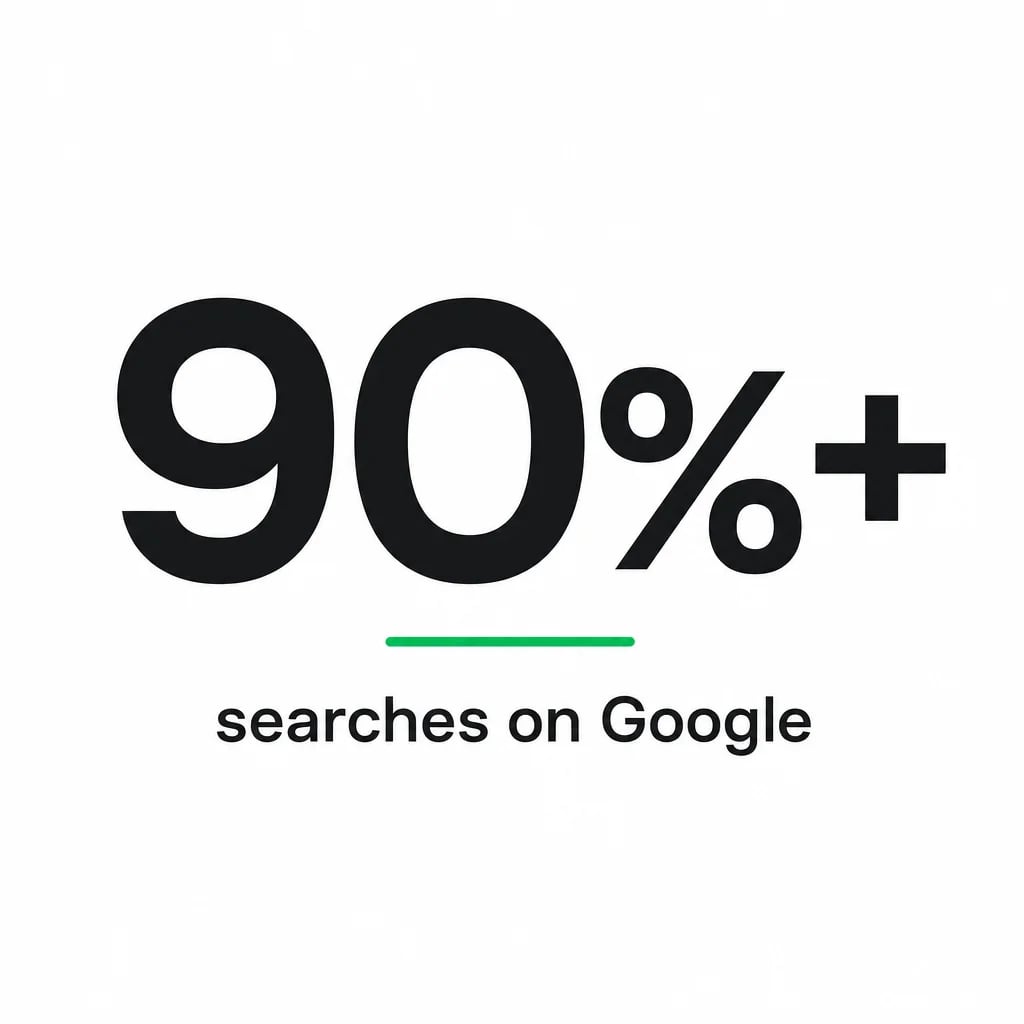
Since over 90% of searches happen on Google, optimizing for Google’s processes is critical Moz: Muller et al., n.d.. But keep in mind, even if you follow all guidelines, search engines don’t guarantee crawling, indexing, or ranking your pages Google Search Central, 2025.
Key Takeaways
- Your site must be discoverable by crawlers through links or sitemaps.
- Fast, error-free servers encourage more frequent crawling.
- Only indexed pages can appear in search results.
- Ranking depends on many factors beyond just being indexed.
What Technical SEO Factors Affect My Website’s Discoverability?
Technical SEO is the backbone that ensures search engines can find, crawl, and index your website efficiently. It covers site speed, mobile readiness, crawl controls, and structured data.
Search engines evaluate your site’s performance using metrics like Page Load Time, Time to First Byte (TTFB), First Contentful Paint (FCP), and Largest Contentful Paint (LCP). For example, Google recommends your LCP be under 2.5 seconds and your First Input Delay under 100 milliseconds to offer a good user experience University Marketing and Communications, n.d..
Slow-loading sites frustrate users, 40% leave if a page takes longer than three seconds to load, and search engines may crawl your site less often or index fewer pages as a result Magna Technology Team, 2023.
Mobile-first indexing means Google primarily looks at your mobile site version for ranking. If your mobile site performs poorly, your visibility suffers regardless of your desktop experience Magruder, 2025.
Other technical essentials include:
- Publishing accurate robots.txt files to guide crawlers.
- Submitting XML sitemaps so search engines know your site structure.
- Fixing broken links and removing resources that block rendering.
- Implementing structured data (schema markup) to help search engines understand your content and enable rich search results Straight North related resource, 2025.
Technical SEO Checklist
- Optimize site speed and server response times.
- Ensure mobile-friendly design and usability.
- Manage crawl instructions with robots.txt and sitemaps.
- Use structured data to enhance search listings.
How Does Content and On-Page SEO Improve My Website’s Visibility?
On-page SEO focuses on the content and HTML elements on your pages that help search engines understand and rank them.
Start with keyword selection. Target a small set of relevant, specific keywords instead of broad, competitive ones. This improves your chances of ranking for terms your audience actually searches for Beel et al., 2009.
Place these keywords strategically:
- In the title tag and main headings (H1, H2), since search engines give these extra weight.
- Naturally throughout the body content, avoiding keyword stuffing that lowers readability and triggers spam filters.
Optimize metadata, file names, and image alt attributes with your keywords to help crawlers correctly identify your page content.
Internal linking with descriptive anchor text guides both users and search engines through your site’s structure and hierarchy Kumar and Paul, 2020.
Avoid embedding critical text as images without text alternatives, as search engines can’t read rasterized text Beel et al., 2009.
On-Page SEO Best Practices
- Choose focused, relevant keywords.
- Use keywords in titles, headings, and metadata.
- Write clear, natural content with keyword variation.
- Link internally with meaningful anchor text.
- Provide text alternatives for images and media.
Remember, on-page SEO helps search engines find and understand your content, but it’s not enough alone. Your site also needs authority signals from outside sources to rank well.
Why Do Off-Page SEO and External Signals Matter for Visibility?
Off-page SEO involves actions outside your website to build trust, authority, and improve rankings. The most important factor here is backlinks, links from other websites pointing to yours.
Search engines see backlinks as votes of confidence. But not all links are equal. Links from high-authority, relevant sites carry more weight than many low-quality links Digitaleer, 2025.
Effective off-page strategies include:
- Creating link-worthy content like original research, guides, or tools that others want to cite Nicol, 2024.
- Guest posting on reputable sites.
- Engaging in digital PR and responding to journalist queries.
- Fixing broken links on other sites by offering your content as a replacement Mmeje, 2025.
For local businesses, optimizing your Google Business Profile and ensuring consistent citations across directories boosts local search visibility Mmeje, 2025.
Social media and influencer engagement can amplify your content, increasing the chance of earning organic links and mentions.
Regularly audit your backlink profile with tools like Moz Link Explorer or Ahrefs to spot lost links, toxic domains, or over-optimized anchor text. Maintaining a healthy link profile supports long-term visibility Mmeje, 2025.
Off-Page SEO Tips
- Focus on quality over quantity for backlinks.
- Build relationships with authoritative, relevant sites.
- Keep your local business listings accurate and consistent.
- Monitor and clean up your backlink profile regularly.
How Can I Know If My Website Is Truly Visible?
Website visibility goes beyond just being online. It means your site is:
- Discoverable by search engines through crawling and indexing.
- Relevant and understandable thanks to good content and SEO.
- Trusted and authoritative via backlinks and external signals.
No single factor guarantees visibility. It’s the combination of technical health, on-page optimization, and off-page authority that makes your website stand out.
Regularly monitor your site’s technical performance, update your content with your audience’s needs in mind, and invest in building external credibility. Even then, search engines don’t promise to crawl or rank every page, so ongoing attention and adaptation are key.
By mastering these layers, you can move from invisible to visible, connecting with customers exactly when and where they search.
Visibility is a journey, but with the right approach, your website can become a powerful asset driving real business growth.
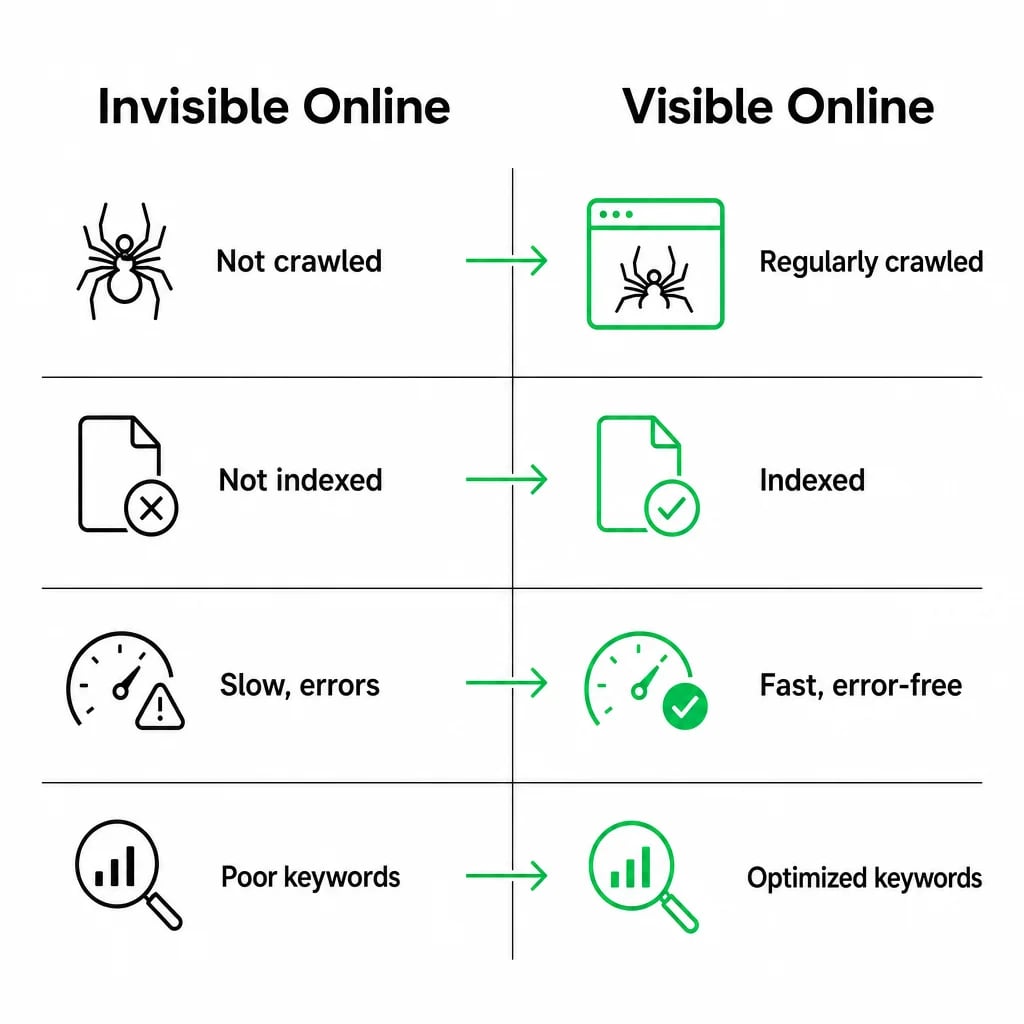
| Website Status | Invisible Online | Visible Online |
|---|---|---|
| Search Engine Crawling | Not crawled due to missing links or sitemap | Regularly crawled via links or submitted sitemap |
| Indexing | Pages blocked, duplicate, or thin content | Pages indexed with relevant, unique content |
| Technical SEO | Slow load times, mobile issues, crawl errors | Fast, mobile-friendly, error-free |
| On-Page SEO | Poor keyword usage, missing metadata, weak internal linking | Optimized keywords, strong metadata, clear internal links |
| Off-Page SEO | Few or low-quality backlinks, weak authority | Quality backlinks, strong authority signals |
Frequently Asked Questions
How do I know if my website is invisible to search engines?
If your website isn’t discoverable through links or a sitemap, or if your pages aren’t indexed, it may be invisible to search engines and won’t appear in search results.
What technical issues can prevent my website from being found online?
Slow site speed, server errors, poor mobile usability, missing or misconfigured robots.txt, and lack of an XML sitemap can all prevent search engines from finding and indexing your website.
How does content quality affect my website’s visibility in search results?
High-quality, relevant content with focused keywords, optimized titles, and clear internal linking helps search engines understand and rank your pages, making your site more visible to users.
Is it true that only backlinks matter for ranking well?
No, while quality backlinks are important for authority, technical SEO and on-page optimization are also essential for search engines to find, index, and understand your site.
What steps can I take to improve my website’s search visibility right now?
Optimize your site speed, ensure mobile usability, submit a sitemap, use relevant keywords in your content and metadata, and build quality backlinks from authoritative sites.