How to Rank Higher on Google in 2026 with Proven SEO
Ranking higher on Google remains essential for any business aiming to grow online. In 2026, Google still dominates with over 90% of web searches happening on its platforms, including Google Images, Maps, and YouTube Moz: Muller et al., n.d.. Being on the first page isn’t optional—most users rarely look beyond it, and top spots capture the lion’s share of clicks. This means better rankings translate directly into more traffic, leads, and sales.
But Google’s ranking system has become increasingly complex. It now evaluates hundreds of signals, from keywords and backlinks to technical site performance, content quality, user engagement, and local relevance Google Search Central, 2025. To rank well in 2026, you need a well-rounded SEO strategy that addresses all these areas.
This guide breaks down the key steps you can take to improve your Google rankings this year. We’ll cover how Google works, the technical basics, content and authority building, and local SEO tactics that help businesses connect with nearby customers.
How Does Google Rank Web Pages Today?
To improve your ranking, you first need to understand how Google finds and ranks pages. The process happens in three main stages: crawling, indexing, and ranking Google Search Central, 2025.
-
Crawling: Google uses automated bots (like Googlebot) to discover pages by following links and sitemaps. If your page isn’t linked or included in a sitemap, it might never be found Moz: Muller et al., n.d..
-
Indexing: Once found, Google analyzes your page’s content, structure, and metadata (such as title tags, headings, and image alt text) to understand its topic and relevance. Technical issues like slow servers or incorrect robots.txt files can block indexing Google Search Central, 2025.
-
Ranking: When a user searches, Google’s algorithms consider hundreds of factors—user intent, location, device, backlinks, and engagement metrics—to decide which pages best answer the query Google Search Central, 2025.
Keep in mind: being crawled doesn’t guarantee indexing, and indexing doesn’t guarantee a high rank. Google never charges for crawling or ranking, and no single factor alone will secure top placement Google Search Central, 2025. Success requires a comprehensive approach that balances technical health, content quality, and authority signals Fehrmann, 2026.
Key Takeaways on Google’s Ranking Process
- Your site must be discoverable through links or sitemaps.
- Content and metadata signal relevance and context.
- Technical issues can block your pages from being indexed.
- Google evaluates many ranking signals to serve the best results.
What Technical SEO Steps Should I Take to Build a Strong Foundation?
Technical SEO ensures Google can efficiently crawl, index, and evaluate your website. Without it, your content and authority won’t matter because Google can’t properly access or understand your pages.
Core Technical Factors to Focus On
-
Page Speed: Fast-loading sites improve user experience and ranking. Google’s Core Web Vitals measure this with metrics like Largest Contentful Paint (LCP), First Input Delay (FID), and Cumulative Layout Shift (CLS). Aim for LCP under 2.5 seconds, FID below 100 milliseconds, and CLS less than 0.1 University Marketing and Communications, n.d..
-
Mobile Readiness: Google primarily uses the mobile version of your site to rank pages. Responsive design, optimized mobile file sizes, and quick mobile load times are essential Magna Technology Team, 2023.
-
Crawlability and Indexability: Use accurate robots.txt files and XML sitemaps to guide Googlebot. Avoid redirect chains and ensure important pages are linked internally for easy discovery Magruder, 2025.
-
Structured Data: Implement schema markup to provide machine-readable context about your content. This can enable rich search results and improve visibility Straight North related resource, 2025.
Practical Technical SEO Tips
- Compress images and minify JavaScript and CSS files to speed up loading.
- Use caching and content delivery networks (CDNs) to reduce server response times.
- Regularly audit your site for broken links or crawl errors.

While technical SEO alone won’t guarantee top rankings, it is the essential groundwork that allows Google to recognize your content and authority Magruder, 2025.
How Can I Optimize My Content and Build Authority?
Effective SEO combines on-page and off-page tactics to improve relevance and trustworthiness.
On-Page SEO: Making Your Content Clear and Relevant
-
Choose keywords thoughtfully and place primary keywords in titles, headings, and throughout the text using natural language and synonyms Beel et al., 2009.
-
Write accurate meta titles, descriptions, and file names that reflect your content and include target keywords Kumar and Paul, 2020.
-
Use internal links with keyword-rich anchor text to help users and search engines navigate your site and understand content relationships Kumar and Paul, 2020.
-
Optimize images and tables with descriptive alt text and vector graphics to ensure all content is indexable Beel et al., 2009.
Off-Page SEO: Building Trust Through Authority
-
Earn high-quality backlinks from reputable, relevant websites. These links remain one of Google’s strongest ranking signals Mmeje, 2025.
-
Use tactics like guest posting, digital PR, and engaging with journalists to gain authoritative mentions Digitaleer, 2025.
-
Monitor your backlink profile with tools such as Moz Link Explorer or Ahrefs to maintain quality and disavow harmful links Mmeje, 2025.
On-page and off-page SEO work best together. Your content must be well-structured and relevant, but external authority validates your site’s trustworthiness in Google’s eyes Beel et al., 2009.
What Local SEO Strategies Help Capture Nearby Customers?
If your business depends on local customers, local SEO is critical. It targets geographically specific searches, including “near me” queries.
How to Optimize for Local Search
-
Google Business Profile (GBP): Claim and verify your GBP. Verified profiles get significantly more views and interactions Thakur, 2025.
-
Engagement: Regularly update business hours, upload high-quality photos, and respond to customer reviews. Active profiles signal trustworthiness to Google Sterling, 2017.
-
On-Site Local Content: Create dedicated location pages with local landmarks, staff bios, and FAQs. Use LocalBusiness and Review schema markup for rich results Wojtalewicz et al., 2025.
-
Consistent Citations: Ensure your business name, address, and phone number (NAP) are consistent across directories like Yelp, Apple Maps, and Facebook. Inconsistencies reduce trust and rankings Wojtalewicz et al., 2025.
-
Reviews: Volume and rating of reviews directly impact local rankings and consumer trust. Encourage steady positive reviews and respond to feedback promptly Thakur, 2025.
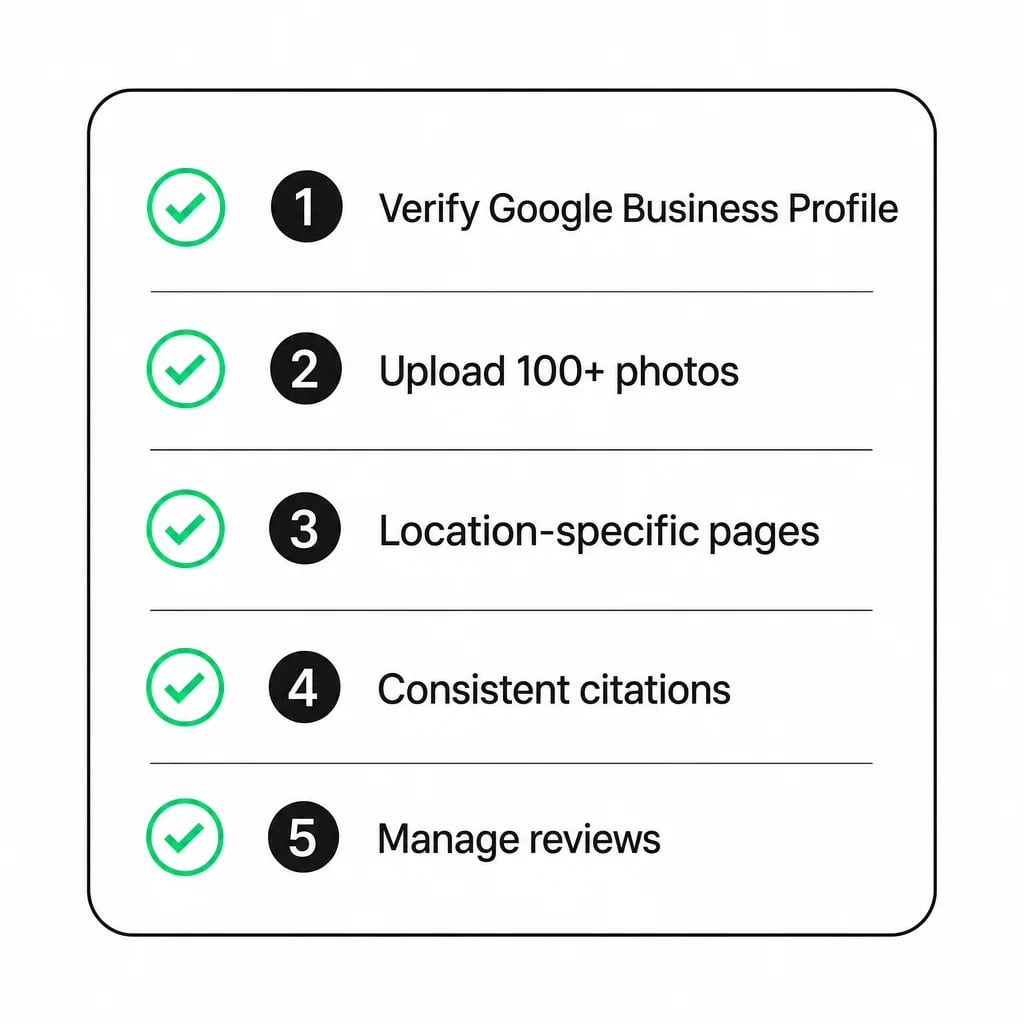
Local SEO Checklist
- Verify and optimize your Google Business Profile.
- Upload 100+ quality photos to boost engagement.
- Build location-specific pages with local schema.
- Maintain citation consistency across directories.
- Actively manage and respond to customer reviews.
What Should I Remember About SEO in 2026?
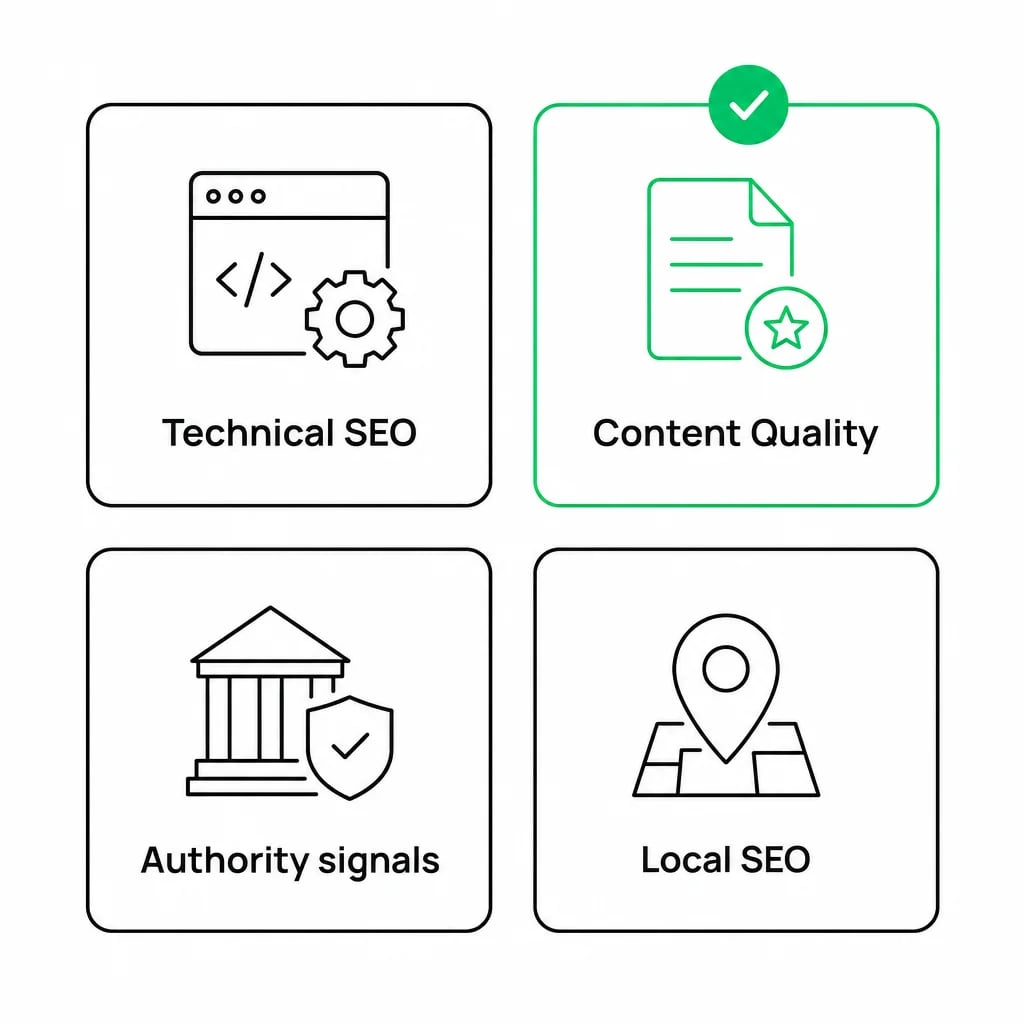
Ranking higher on Google in 2026 requires a balanced, ongoing effort across multiple fronts. Technical SEO lays the groundwork by making your site fast, mobile-friendly, and crawlable. On-page SEO ensures your content is relevant and accessible. Off-page SEO builds the authority Google trusts. Local SEO connects you with customers in your area.
There is no single trick or shortcut. SEO is a process of continuous measurement, testing, and refinement. By adopting a holistic strategy that integrates technical excellence, quality content, authority signals, and local optimization, you position your website for lasting visibility and growth.
Stay informed about Google’s evolving algorithms and user behaviors. Regularly update your approach to keep your rankings strong now and into the future.
By focusing on these proven strategies, your website can climb Google’s rankings in 2026 and beyond, driving more traffic and growing your business.
| Traditional SEO (Pre-2026) | Modern SEO (2026) |
|---|---|
| Focused mainly on keywords and backlinks | Requires a balanced approach including technical SEO, content quality, authority, and local relevance |
| Desktop optimization prioritized | Mobile-first indexing and responsive design are essential |
| Manual site audits and updates | Ongoing audits, automation, and use of structured data/schema markup |
| Local SEO was optional for some businesses | Local SEO is critical for businesses targeting nearby customers |
| Ranking factors were fewer and less complex | Google evaluates hundreds of signals, including user intent, engagement, and Core Web Vitals |
Frequently Asked Questions
How does Google decide which websites rank higher in 2026?
Google ranks websites by analyzing hundreds of factors including content relevance, technical site performance, backlinks, user engagement, and local signals to determine which pages best answer a user's query.
What are the most important technical SEO steps to improve my website’s ranking?
Focus on site speed, mobile readiness, crawlability, indexability, and implementing structured data to ensure Google can efficiently access and understand your website.
How can I build authority for my website to improve rankings?
Earn high-quality backlinks from reputable sites, engage in guest posting and digital PR, and monitor your backlink profile to maintain trust and authority.
Is it true that technical SEO alone is enough to rank at the top of Google?
No, technical SEO is essential but not sufficient; you also need high-quality content, strong authority signals, and local optimization for top rankings.
What steps should I take to improve my local SEO for nearby customers?
Claim and optimize your Google Business Profile, ensure consistent business information across directories, create local content, and actively manage customer reviews.