What are the different types of marketing in 2026?
Marketing in 2026 is a complex ecosystem shaped by digital transformation, multiple channels, and data-driven strategies. Businesses now compete in a crowded digital space where success depends on understanding the distinct types of marketing and how they work together. This article breaks down the main marketing types in 2026, explains how to integrate them effectively, clarifies the differences between paid and organic approaches, and highlights why measurement and attribution are essential for optimizing your marketing efforts.
What Are the Core Digital Marketing Channels in 2026?
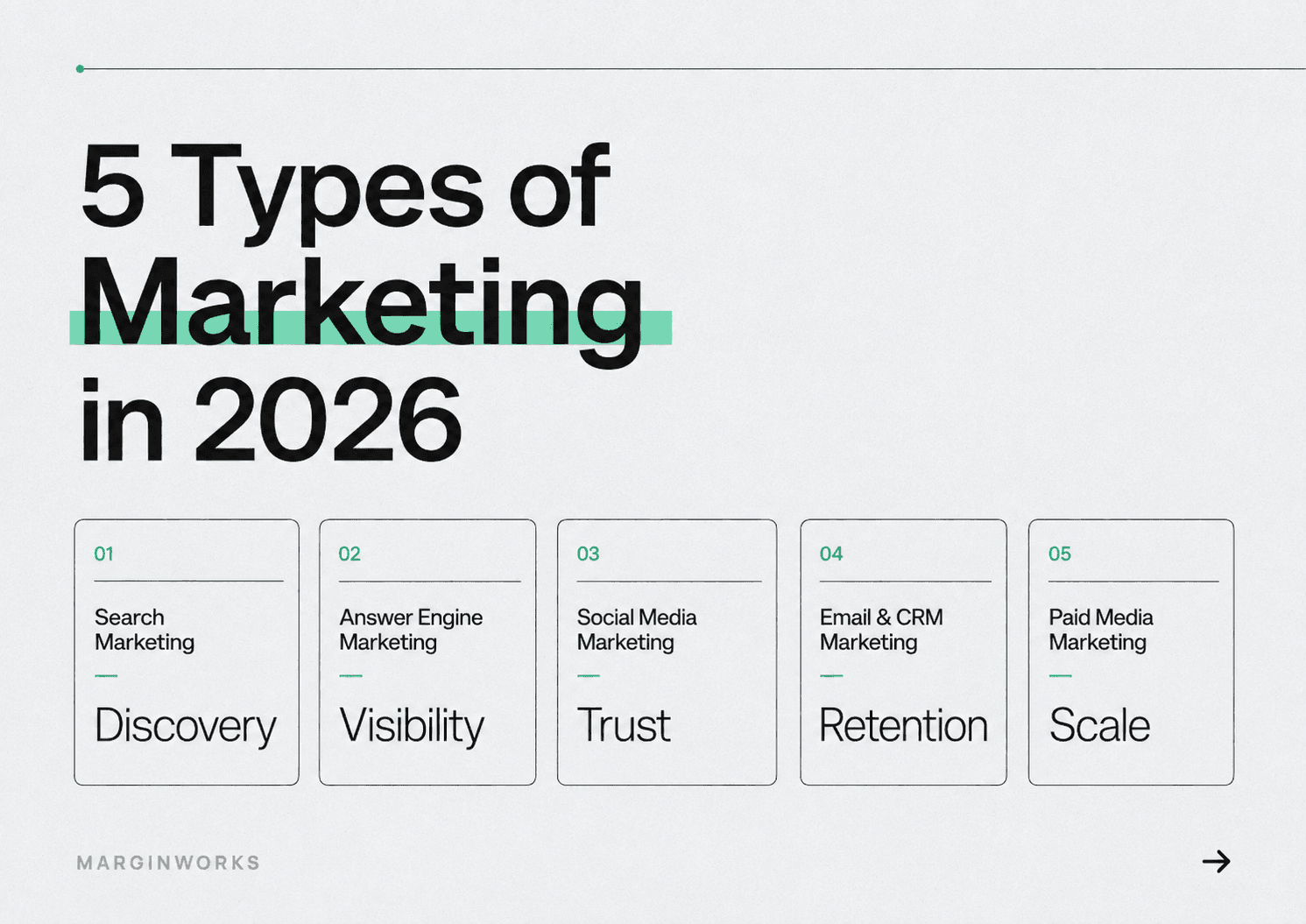
The primary digital marketing channels in 2026 include search, content marketing, social media, email, and paid advertising. Each channel has a unique role but works best when combined strategically.
- Search marketing covers SEO (organic search optimization) and SEM (paid search ads). It targets users actively searching for products or services by improving visibility on search engines like Google.
- Content marketing creates valuable assets, blogs, videos, guides, that build brand authority and support SEO and social distribution.
- Social media marketing leverages platform creativity and community engagement to amplify content and promotions.
- Email marketing delivers personalized messages to nurture leads and encourage repeat business, often offering a strong return on investment.
- Paid advertising includes pay-per-click (PPC), display ads, and social ads, providing immediate reach with precise targeting but requiring ongoing budget management Coursera Staff, 2025.
These channels are interconnected within a strategic framework combining owned media (your website and email lists), earned media (social shares and word-of-mouth), and paid media (ads). Each supports different stages of the customer journey: search and content drive discovery, social media fosters engagement, email nurtures leads, and paid channels accelerate acquisition Monash University, 2025.
Why Integration Matters
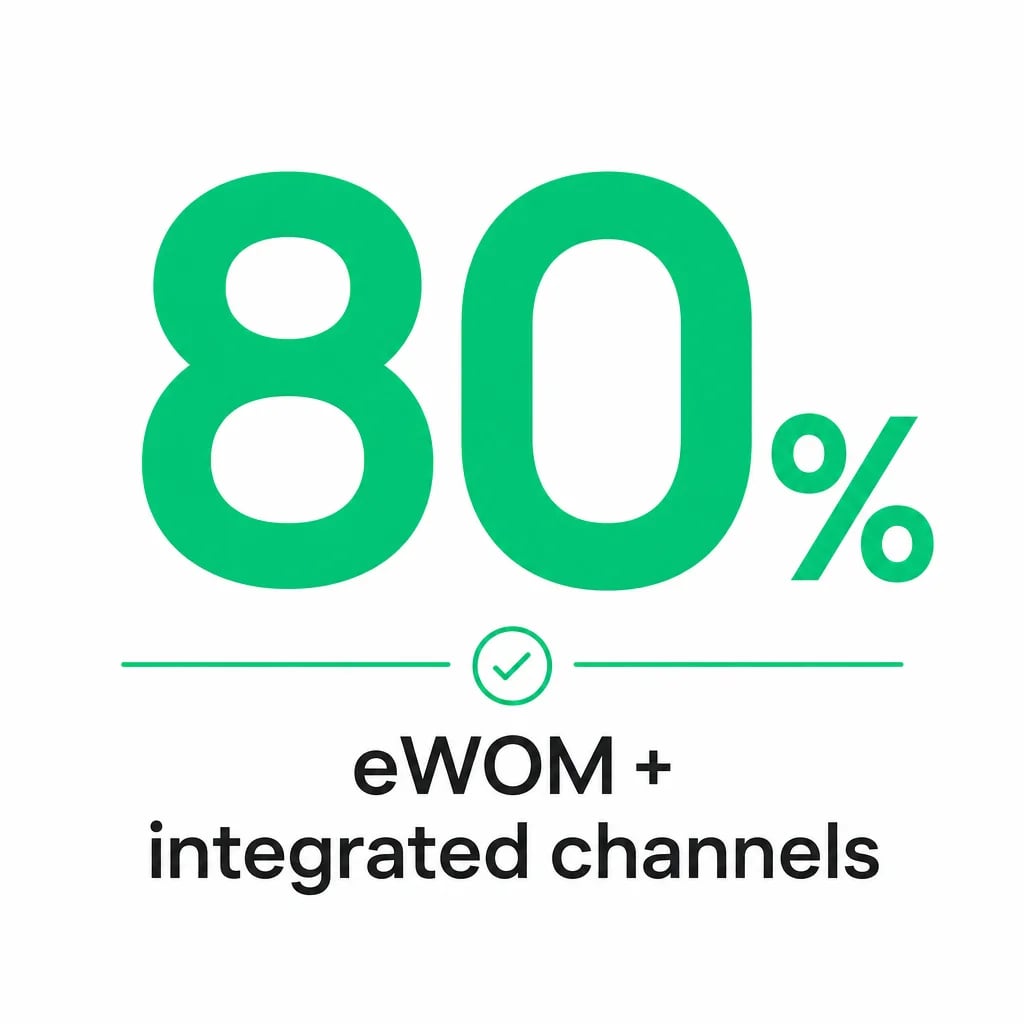
Research shows that combining multiple channels with electronic word-of-mouth (eWOM) explains over 80% of consumer buying decisions, proving that integrated marketing outperforms isolated tactics Al Kurdi et al., 2022.
How Should Marketing Channels Be Integrated for Maximum Impact?
Using multiple channels is not enough. In 2026, successful marketing requires a coordinated, measurement-driven approach.
Start by defining clear objectives and mapping your customer funnel stages: awareness, consideration, acquisition, retention, and advocacy. Assign each channel to the stage it serves best. For example:
- Search and content for discovery
- Social media for amplification and engagement
- Email for retention and nurturing
- Paid advertising for rapid acquisition Monash University, 2025
Next, audit your owned assets and audience segments to choose channels where your customers spend time. Define key performance indicators (KPIs) for each channel, such as traffic, click-through rates, and conversion rates Coursera Staff, 2025.
Best Practices for Channel Integration
- Use analytics platforms for real-time testing and refining your channel mix. Prioritize channels based on your goals: SEM and paid search for immediate acquisition; SEO and content for long-term visibility; segmented email for personalized engagement; paid social and display for testing creative ideas.
- Avoid treating channels in isolation or underinvesting in measurement.
- Respect privacy regulations while managing data.
- Recognize channel interdependence: content fuels SEO and social, social amplifies content and generates eWOM, and email consolidates relationships started elsewhere Coursera Staff, 2025.
What Are the Strategic Differences Between Paid and Organic Marketing?
Paid and organic marketing strategies play complementary but distinct roles in 2026.
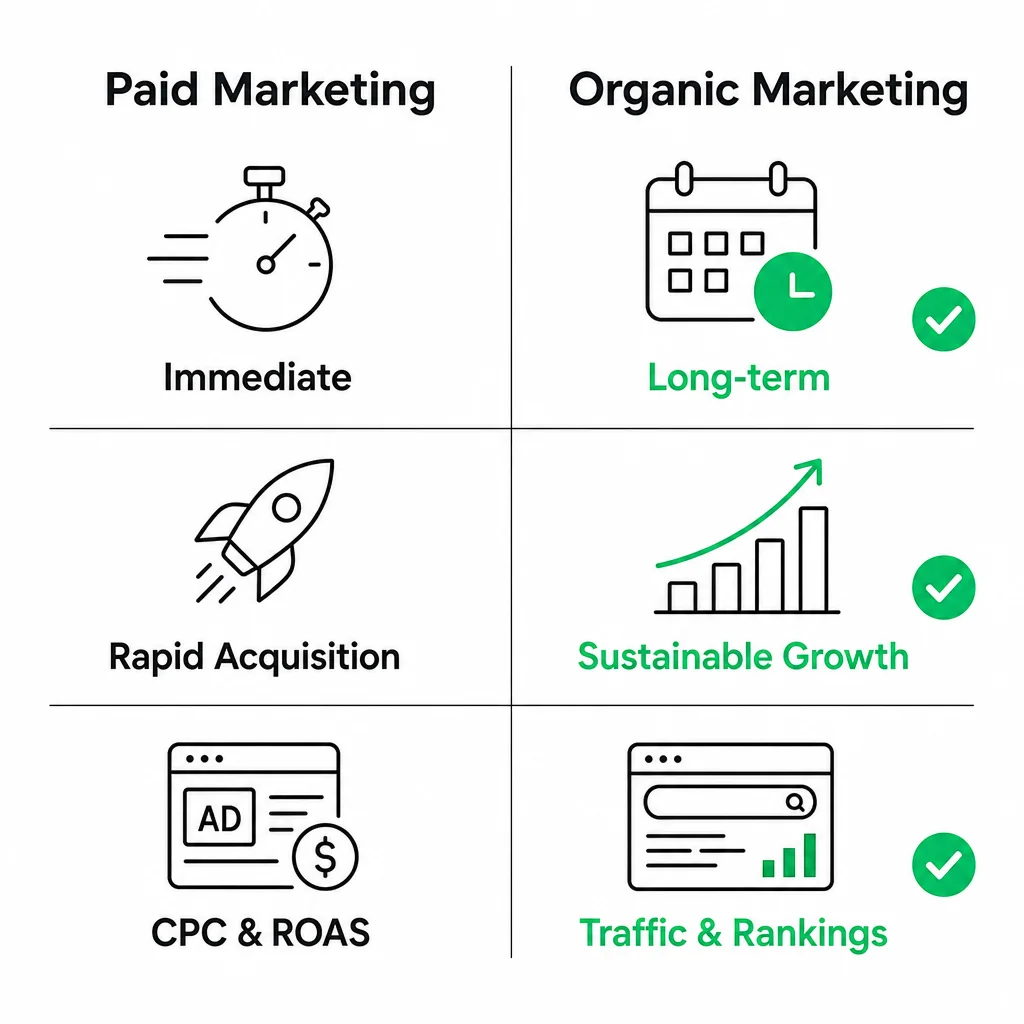
- Paid marketing involves spending on ads, PPC, social ads, influencer partnerships, to get immediate, targeted exposure and quick results.
- Organic marketing builds audience trust and equity over time through SEO, content, social engagement, and email lists without direct ad spend BITA, n.d..
Paid tactics are ideal for rapid awareness and conversions, while organic tactics excel at long-term growth and credibility Schooley, 2026.
How to Combine Paid and Organic Marketing Effectively
- Use paid campaigns to test offers, generate data, and seed awareness.
- Leverage insights from paid performance—like top keywords and creatives—to guide organic SEO and content strategies.
- Track different KPIs: paid channels focus on short-term metrics like cost-per-click (CPC) and return on ad spend (ROAS), while organic channels measure long-term growth in traffic, rankings, and subscriber engagement BITA, n.d..
- Remember, paid marketing delivers immediate reach and data, while organic marketing builds sustainable traffic and trust Luth Research, n.d..
How Does Measurement and Attribution Drive Marketing Success?
Measurement and attribution are the backbone of effective marketing in 2026. They ensure every dollar spent is accountable and optimized.
Marketers track metrics across four key layers:
- Traffic: How many people are reached?
- Engagement: How well does content resonate?
- Conversion: How efficiently do marketing efforts turn prospects into customers?
- Retention: How valuable are customers over time? Santa Clara University, 2023
Start by defining your campaign’s primary goal and “north star” metric. Then map supporting KPIs to funnel stages to monitor progress Sampath, 2024.
What Is Attribution Modeling and Why Does It Matter?
Attribution models assign credit for conversions across multiple touchpoints. Basic models like last-touch attribution are simple but can misrepresent channel value in complex journeys.
Advanced models—such as Markov chains or game-theoretic approaches—consider interactions and carryover effects, giving a more accurate view of each channel’s contribution Gaur & Bharti, 2020.
Continuous improvement relies on funnel analysis, A/B testing, and iterative optimization fueled by diagnostic and predictive analytics Santa Clara University, 2023.
Integrating analytics platforms with strong data governance ensures insights are actionable and reliable, allowing marketers to make agile decisions in a fast changing environment William & Mary, 2025.
What Does This Mean for Marketers in 2026?
Marketing in 2026 is about mastering a dynamic, integrated system where channels support each other and every action is measured. Search, content, social, email, and paid advertising each have unique strengths, but their true power comes from working together in an omnichannel strategy aligned with business goals.
Paid and organic tactics complement one another—paid brings immediate impact, organic builds lasting value. Meanwhile, advanced measurement and attribution frameworks ensure marketing investments deliver measurable results.
As privacy rules tighten and consumer expectations evolve, marketers must stay agile. Using data-driven insights, continuous testing, and cross-channel integration will be key to staying ahead and delivering value throughout the customer journey.
| Marketing Approach | Key Features in 2026 |
|---|---|
| Paid Marketing | Delivers immediate reach and targeted exposure through PPC, social ads, and influencer partnerships; ideal for rapid awareness and conversions; requires ongoing budget management. |
| Organic Marketing | Builds long-term trust and brand authority using SEO, content, social engagement, and email lists; excels at sustainable growth without direct ad spend. |
| Channel Integration | Combines multiple digital channels (search, content, social, email, paid) for greater impact; aligns each channel to specific customer journey stages. |
| Measurement & Attribution | Uses analytics and advanced attribution models to track performance, optimize spending, and assign credit across channels for conversions. |
| Traditional (Isolated) Marketing | Relies on single-channel tactics with limited measurement, often missing the benefits of cross-channel synergy and real-time optimization. |
Frequently Asked Questions
What are the main types of digital marketing channels in 2026?
The main digital marketing channels in 2026 are search marketing (SEO and SEM), content marketing, social media, email, and paid advertising, each playing a unique role in reaching and engaging customers.
How do paid and organic marketing differ in their impact?
Paid marketing delivers quick, targeted results through ads, while organic marketing focuses on building long-term trust, credibility, and sustainable traffic without direct ad spend.
Why is integrating multiple marketing channels more effective than using just one?
Integrating channels amplifies reach and influence, with research showing that a combined approach with electronic word-of-mouth explains over 80% of consumer buying decisions.
How can small businesses measure the effectiveness of their marketing efforts?
Small businesses should track metrics across traffic, engagement, conversion, and retention, using analytics platforms and attribution models to understand which channels drive results and optimize their strategies.
Is it necessary to use both paid and organic tactics, or can one be enough?
Using both paid and organic tactics is recommended because paid marketing delivers immediate impact, while organic builds lasting value; together, they create a balanced and resilient marketing strategy.