How AI Automates Daily Business Operations for Better Results
In today’s fast-paced business environment, automating daily operations with Artificial Intelligence (AI) is no longer optional—it’s essential. AI helps businesses streamline repetitive tasks, improve accuracy, and deliver personalized customer experiences at scale. But automation with AI goes beyond simply cutting manual work; it empowers your team to focus on strategic, high-value activities while AI handles routine processes efficiently.
This article will guide you through practical ways to automate your daily business operations using AI. We’ll cover embedding AI into customer interactions, automating sales and onboarding workflows, enhancing decision-making with AI-driven support, and the critical role of governance and human oversight. By the end, you’ll understand how to implement AI automation thoughtfully and effectively to grow your business.
How Can AI Improve Customer Interactions in Daily Operations?
Automating customer interactions is a foundational step in AI-driven business operations. AI-powered tools like chatbots, automated support systems, and recommendation engines can handle routine inquiries, offer personalized suggestions, and deliver predictive insights that improve service and marketing efforts Tarafdar et al., 2020; Chapman Graduate School, 2023.
What Are the Key Stages of AI in Customer Interaction?
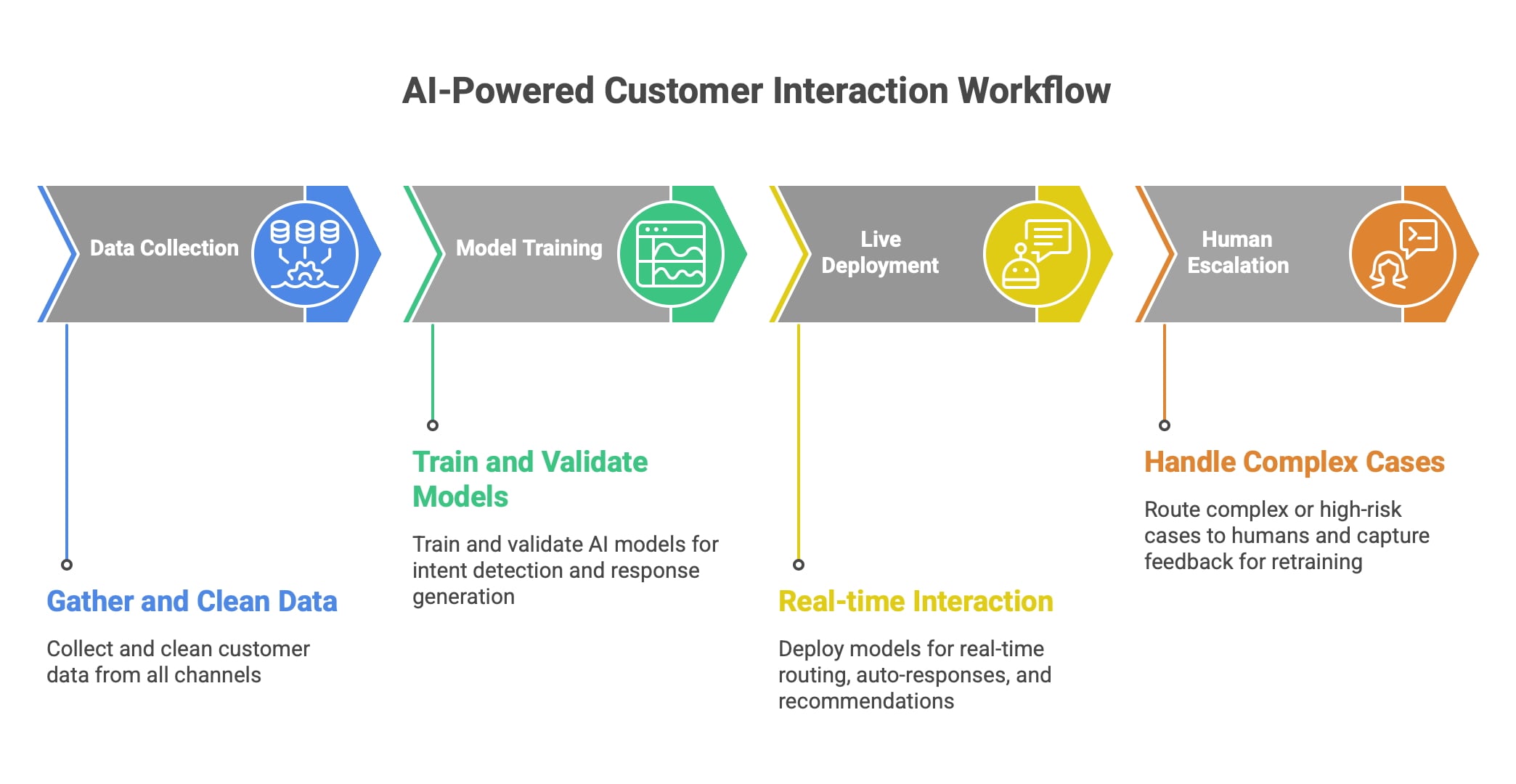
AI automation in customer-facing applications typically follows this four-stage pipeline:
-
Data Ingestion and Management: Collect and organize high-quality customer data, including chat logs, transactions, and feedback. Good data governance here is crucial because AI’s accuracy depends on the quality of its data Chapman Graduate School, 2023.
-
Model Training and Selection: Choose the right AI models for tasks like detecting customer intent, generating responses, or personalizing recommendations. Models are trained and validated to ensure fairness and accuracy Tarafdar et al., 2020.
-
Inference and Orchestration: Embed AI models into applications that respond in real-time—routing support tickets, auto-answering questions, or suggesting products dynamically Tarafdar et al., 2020.
-
Human-in-the-Loop Escalation: AI handles routine cases but escalates complex or high-risk issues to human agents, capturing feedback to continuously improve the system Tarafdar et al., 2020.
What Business Benefits Can I Expect?
Replacing simple chatbot scripts with generative AI enables 24/7 personalized support, enhancing customer satisfaction Chapman Graduate School, 2023. Personalization engines can drive significant revenue—Amazon credits up to 35% of its sales to such AI-driven recommendations Chapman Graduate School, 2023.
What Should I Watch Out For?
Successful AI deployment requires more than plugging in technology. Align your business processes, invest in data governance, and train your staff to work alongside AI. Without these, automation can fail or even introduce new inefficiencies Tarafdar et al., 2020. Remember, AI transforms jobs rather than replaces them, so plan for workforce reskilling Chapman Graduate School, 2023.
How Can I Automate Sales and Onboarding Workflows?
Sales and onboarding involve many repetitive tasks that are ideal for AI automation. Streamlining these processes accelerates revenue generation, reduces errors, and improves experiences for customers and employees alike Salesforce, n.d.; Aptitude Research, 2022.
What Does Sales Operations Automation Look Like?
-
Lead Capture and Qualification: AI ingests inbound leads from marketing channels into a centralized CRM, creating clean prospect records DealHub, n.d..
-
Lead Scoring and Routing: Automated systems score leads based on potential and route them to the right sales reps, speeding up responses and improving conversion rates DealHub, n.d..
-
Outreach and Follow-Up: Workflow automation handles outreach cadences, meeting scheduling, and follow-ups without manual input Salesforce, n.d..
-
Proposal and Quoting: Sales enablement tools provide templated proposals, while Configure-Price-Quote (CPQ) systems automate quoting and approvals, reducing sales cycles and increasing revenue DealHub, n.d..
What Are the Measurable Benefits?
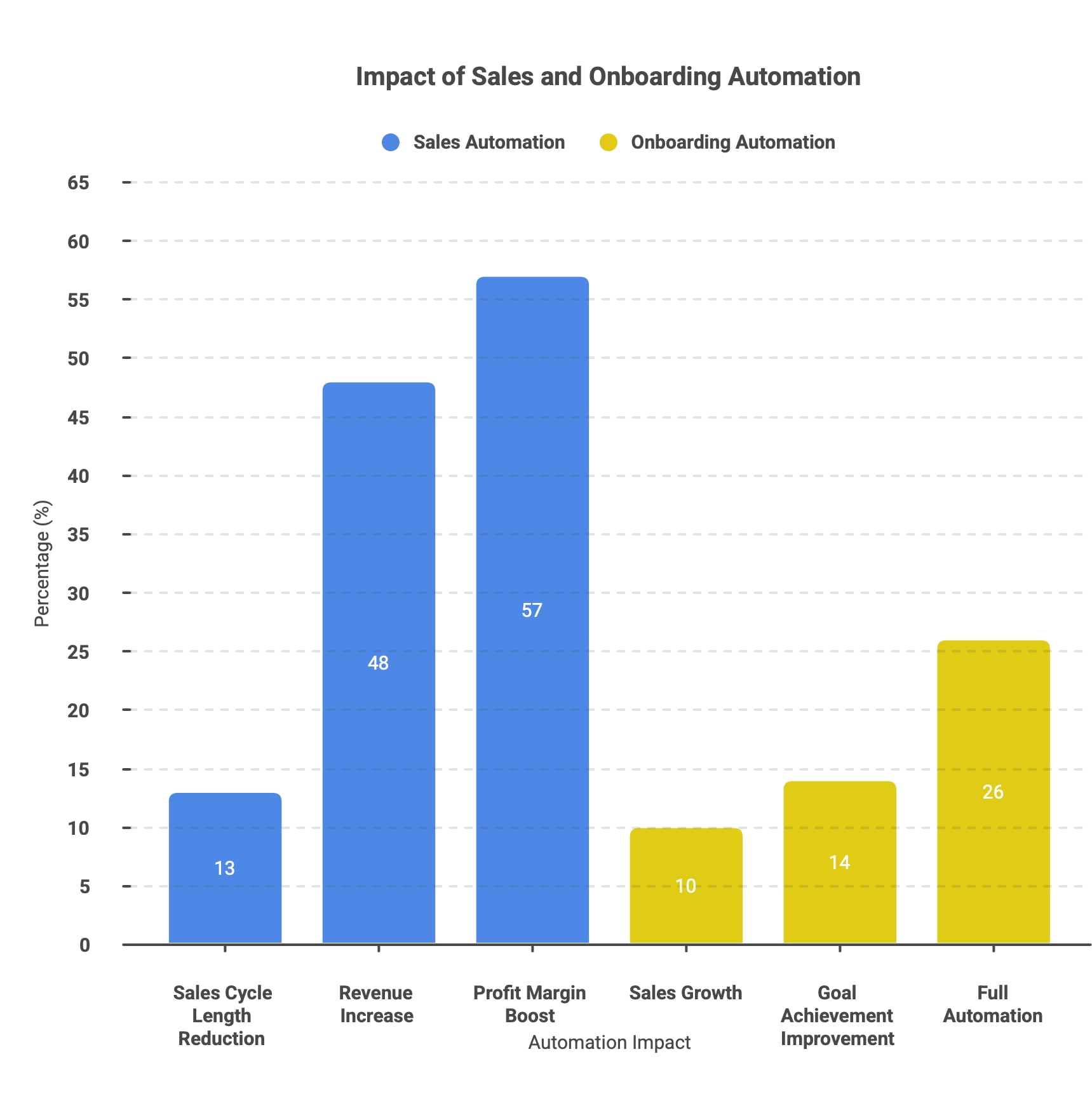
Using CPQ can reduce sales cycles by 13%, increase revenue by 48%, and boost profit margins by 57% DealHub, n.d.. However, these results depend on clean data and strong CRM adoption. Over-automation without sales team input may hinder adoption Salesforce, n.d..
How Does Onboarding Automation Help?
Onboarding automation ensures every new client or employee receives a consistent and timely introduction without manual effort Aptitude Research, 2022. It includes:
- Pre-start engagement and centralized access to resources
- Automated proposal and quoting tools with guided selling
- Approval workflows to enforce pricing and discount policies
- Structured knowledge transfers and milestone tracking
Companies that automate onboarding well see 10% higher sales growth and 14% better achievement of sales and profit goals Orgil, 2025. Yet, only 26% of firms fully automate onboarding, often limiting programs to two weeks, missing longer-term benefits Aptitude Research, 2022.
How Does AI Enhance Decision-Making in Business Operations?
AI-powered decision support systems (DSS) transform raw business data into actionable insights. By analyzing structured and unstructured data with machine learning (ML) and natural language processing (NLP), AI delivers concise summaries, ranked options, and daily briefings that help leaders make faster, smarter decisions Polinati et al., 2025; Rihiant, 2026.
What Is the AI Decision Support Pipeline?
-
Data Acquisition and Preprocessing: Aggregate data from internal systems like ERP and CRM, plus external sources such as market reports.
-
Model Inference: Use predictive analytics and ML to detect patterns and score options; NLP extracts key facts and creates readable daily summaries Fauscette, n.d..
-
Presentation and Interaction: Deliver insights through dashboards or email briefings.
-
Governance and Feedback: Log decisions, enable human validation, and retrain models based on outcomes Rihiant, 2026.
What Are Practical Use Cases?
Retailers use AI for inventory forecasting and personalized marketing. Manufacturers apply ML for predicting equipment failures and scheduling maintenance, reducing downtime Polinati et al., 2025.
What Are Best Practices for AI Decision Support?
- Ensure data quality and governance for reliable recommendations.
- Maintain human-in-the-loop validation, especially for high-stakes decisions Rihiant, 2026.
- Shift from descriptive analytics to predictive and prescriptive models for anticipatory insights Fauscette, n.d..
What Is the “Daily Briefing” Approach?
A daily briefing delivers a concise AI-generated summary of key metrics—leads, revenue, risks—to start each day informed and focused SkhokhoAI, 2025. This requires automated data collection, AI filtering, and alignment with business KPIs Warin, 2024.
How Should I Govern AI Automation and Maintain Human Oversight?
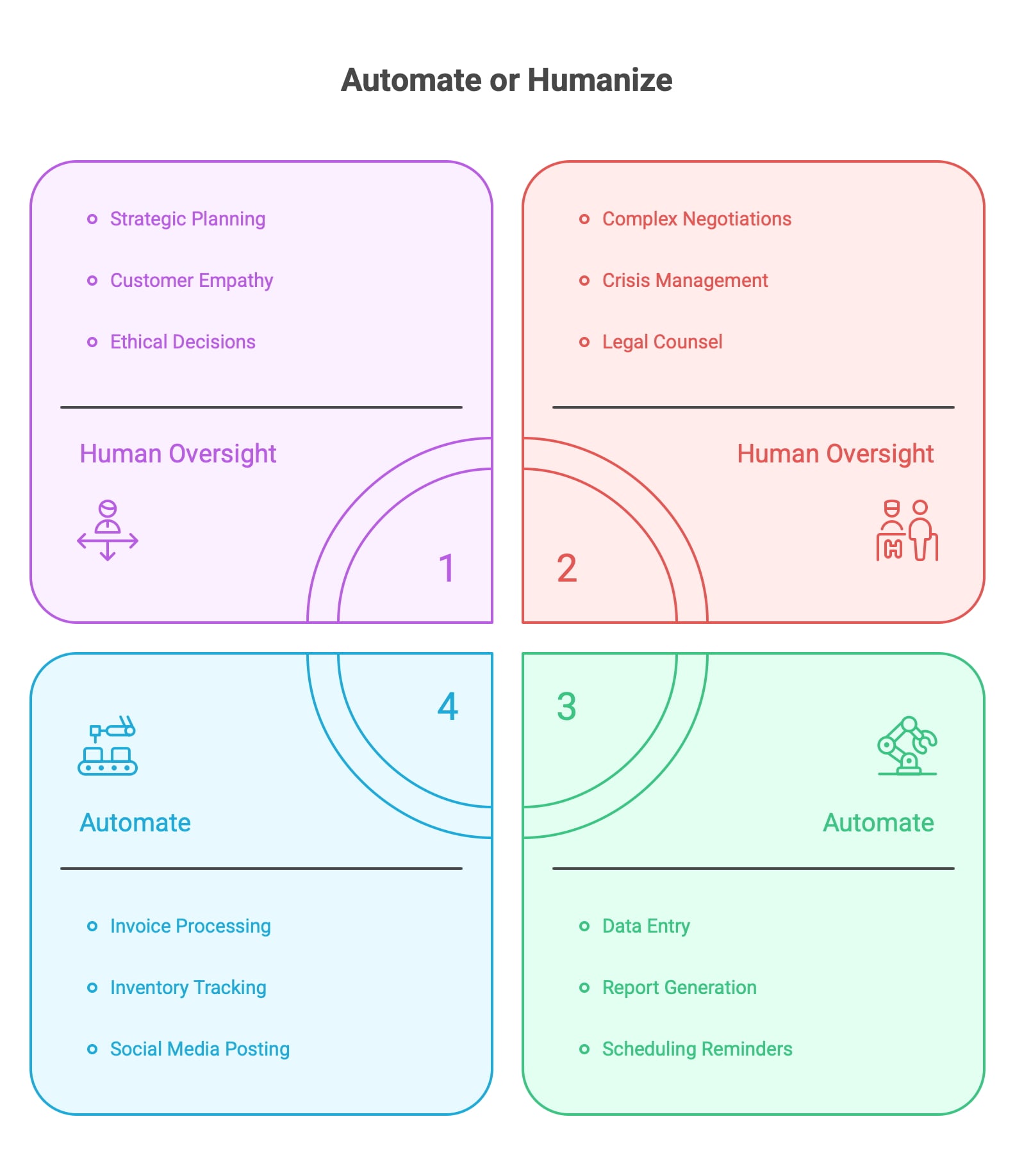
Not all tasks should be fully automated. Balancing AI efficiency with human judgment ensures your business avoids costly errors and ethical pitfalls Lovelace and Alzoubi, 2025.
How Do I Decide What to Automate?
Classify tasks by:
- Repeatability: How often is the task done the same way?
- Consequence of Error: What’s the impact of mistakes?
- Need for Context or Ethics: Does the task require judgment or ethical evaluation?
Automate high-repeatability, low-risk tasks. Retain human control for complex or high-impact decisions, with mandatory review layers where regulations or safety are involved Lovelace and Alzoubi, 2025.
What Governance Practices Are Essential?
- Train staff to audit and override AI decisions.
- Monitor AI performance, user engagement, and decision quality.
- Establish escalation protocols for AI errors or bias Lovelace and Alzoubi, 2025.
What Organizational Changes Support Successful Automation?
Automation is a transformation, not just technology deployment. It requires:
- Clear accountability and ownership
- Employee engagement and feedback loops
- Continuous education on AI capabilities and limitations Melendez, 2025
Ongoing development in algorithmic auditing and human-in-the-loop governance is key to mitigating risks and maximizing AI’s benefits Lovelace and Alzoubi, 2025.
What Are the Key Takeaways for Automating Daily Business Operations with AI?
Automating your daily operations with AI can boost efficiency, accuracy, and customer satisfaction. Start by embedding AI into customer-facing applications to handle routine tasks and personalize experiences. Automate sales and onboarding workflows to accelerate revenue and ensure consistent processes. Use AI-powered decision support to gain timely, actionable insights.
Success depends on strong data governance, clear process alignment, and maintaining human oversight where judgment matters. Automation isn’t a one-time fix—it’s an ongoing journey requiring discipline, skills development, and continuous improvement.
By following these principles, your business can unlock the full potential of AI-driven automation, gaining agility and competitive advantage while preserving the human creativity and judgment that drive long-term success.

Knowledge Gaps
This article does not cover:
- Step-by-step implementation guides for specific AI tools or platforms.
- Detailed case studies from small businesses beyond cited benchmarks.
- Recent legal or regulatory updates on AI automation post-2026.
- In-depth AI ethics frameworks beyond governance and oversight.
- Industry-specific automation examples outside sales, onboarding, and customer service.
Avoid making claims in these areas without additional sources.
| Manual Business Operations | AI-Automated Business Operations |
|---|---|
| Staff handle repetitive tasks manually, leading to slower processes and higher error rates. | AI automates routine tasks, improving speed, accuracy, and freeing staff for high-value work. |
| Customer inquiries are addressed by humans, often with delays and inconsistent responses. | AI-powered chatbots and support systems provide 24/7, personalized customer service. |
| Sales and onboarding workflows are managed by employees, increasing the risk of missed steps and inconsistent experiences. | Automated workflows streamline lead capture, scoring, and onboarding, ensuring consistency and faster revenue generation. |
| Decision-making relies on manual data gathering and analysis, which can be slow and incomplete. | AI decision support systems deliver real-time insights, predictive analytics, and daily briefings for faster, smarter decisions. |
| Oversight is entirely human, increasing the chance of oversight fatigue and missed risks. | AI systems escalate complex cases to humans, with governance protocols to maintain oversight and auditability. |
Frequently Asked Questions
How can AI help automate daily business operations for small and mid-size businesses?
AI automates repetitive tasks, streamlines customer interactions, accelerates sales and onboarding workflows, and delivers actionable insights, allowing your team to focus on strategic activities.
What are the key steps to successfully implement AI automation in business processes?
Start by organizing quality data, select and train the right AI models, embed them into workflows, and ensure human oversight for complex or high-risk cases.
What measurable benefits can I expect from automating sales and onboarding with AI?
You can reduce sales cycles by 13%, increase revenue by 48%, and boost profit margins by 57% when automating sales operations, with onboarding automation leading to higher sales growth and goal achievement.
How does AI-powered decision support improve business operations?
AI analyzes your business data to provide concise summaries, ranked options, and daily briefings, helping leaders make faster and more informed decisions.
Is it necessary to keep humans involved when automating business operations with AI?
Yes, maintaining human oversight is critical for high-impact or complex decisions, ensuring quality, ethical standards, and the ability to audit or override AI when needed.