How to Start Automating My CRM in 2026
Automating your Customer Relationship Management (CRM) system is no longer optional, it’s essential. Automation helps businesses scale revenue, enhance customer experience, and free teams from repetitive tasks. But where do you begin? A well-planned CRM automation strategy can prevent lost leads, speed up sales cycles, and lay the groundwork for AI-driven insights. On the flip side, a rushed or unstructured rollout risks amplifying data chaos and bottlenecks Bangia et al., 2020.
This guide walks you through the crucial first steps to automate your CRM effectively. From mapping your processes and cleaning your data to building a solid technical setup and automating lead capture, nurturing, and reporting, you’ll learn how to connect automation to real business results. Whether you run a small business or a mid-size company, these fundamentals will help you launch a CRM automation initiative that delivers measurable value in 2026 and beyond Yuen, 2025.
How Do I Begin with Process Mapping and Data Hygiene?
Before investing in automation tools, start by understanding your current sales and customer workflows. Process mapping is the practice of visually documenting all activities, participants, inputs, decision points, and handoffs involved in delivering your business outcomes Casanova et al., 2022. This step uncovers manual handoffs, spreadsheet dependencies, and bottlenecks that are ripe for automation Moxo Team, 2025.
Begin by defining where your process starts and ends, who is involved, and what the expected results are. Interview your team members, gather process documents, and create swimlane diagrams to capture the actual “as-is” workflow Casanova et al., 2022.

Once you have a clear process map, focus on data hygiene. Automation magnifies your current data quality, good or bad. Inconsistent field names, duplicate records, and missing information will sabotage even the best automation efforts Yuen, 2025.
To avoid this, define standard field names, ownership rules, and role-based access controls so each team member sees only relevant data Yuen, 2025. Without this foundation, automation will only speed up errors and create reconciliation headaches.
What Should I Prioritize After Mapping and Cleaning?
Validate your process map with frontline users. Then, prioritize which steps to automate based on:
- Frequency of the task
- Clear rule-based logic
- Vulnerability to errors or cross-system issues
This approach ensures you automate the right parts first and don’t just move bottlenecks around Zaupper & Burke, 2024 Casanova et al., 2022.
How Do I Build a Technical Architecture for CRM Automation?
With your processes mapped and data cleaned, design a technical architecture that supports scalable automation. Most organizations use a hub-and-spoke model where the CRM is the central hub, integrating with marketing, accounting, and support systems Yuen, 2025.
This architecture should be modular and repeatable: map processes, select platforms, design data flows, implement automations, and iterate with measurement and training Yuen, 2025.
What Are the Key Technical Considerations?
- Choose a CRM platform that hosts customer records and integrates two-way with your other core systems (e.g., accounting, payment processors) Yuen, 2025.
- Design your data model with standardized field mappings.
- Use adapters or connectors for each SaaS tool in your stack.
- Consider middleware or integration platforms (iPaaS) to handle data transformations, retries, and error logging as you scale Yuen, 2025.
Security and governance are non-negotiable. Enforce role-based access, encrypt data in transit and at rest, and conduct regular security assessments to avoid new vulnerabilities Fujifilm, 2025.
If IT resources are limited, prioritize cloud-first, low-code, or no-code solutions to reduce engineering overhead and speed up pilots BizTech Magazine, 2026.
How Should I Test and Measure My Architecture?
Start with a pilot focused on clear KPIs such as lead response time, sales cycle length, and pipeline conversion rates. Use these metrics to iterate and improve before scaling automation across your organization BizTech Magazine, 2026.
What’s the Best Way to Automate Lead Capture, Scoring, and Routing?
Your first automation win often comes from streamlining lead capture and initial response. This “first touch” automation captures prospect contacts from web forms, landing pages, telephony, or chatbots and automatically tags, scores, and routes them in your CRM Meritto, 2023.
The goal is to ensure no leads slip through, maintain consistent attribution, and engage sales-ready prospects immediately while nurturing lower-intent contacts automatically Huggins and Hansen, 2023.
How Does Lead Capture Automation Work?
The process involves five key steps:
- Capture leads from forms, landing pages, or chat interfaces.
- Ingest and enrich data in the CRM, adding firmographic or intent data if available.
- Apply automated tagging and segmentation for attribution and reporting.
- Score leads using rules or AI models to assess intent and fit.
- Trigger immediate actions like autoresponders or human assignment based on scores and routing rules B2B Rocket, 2024.
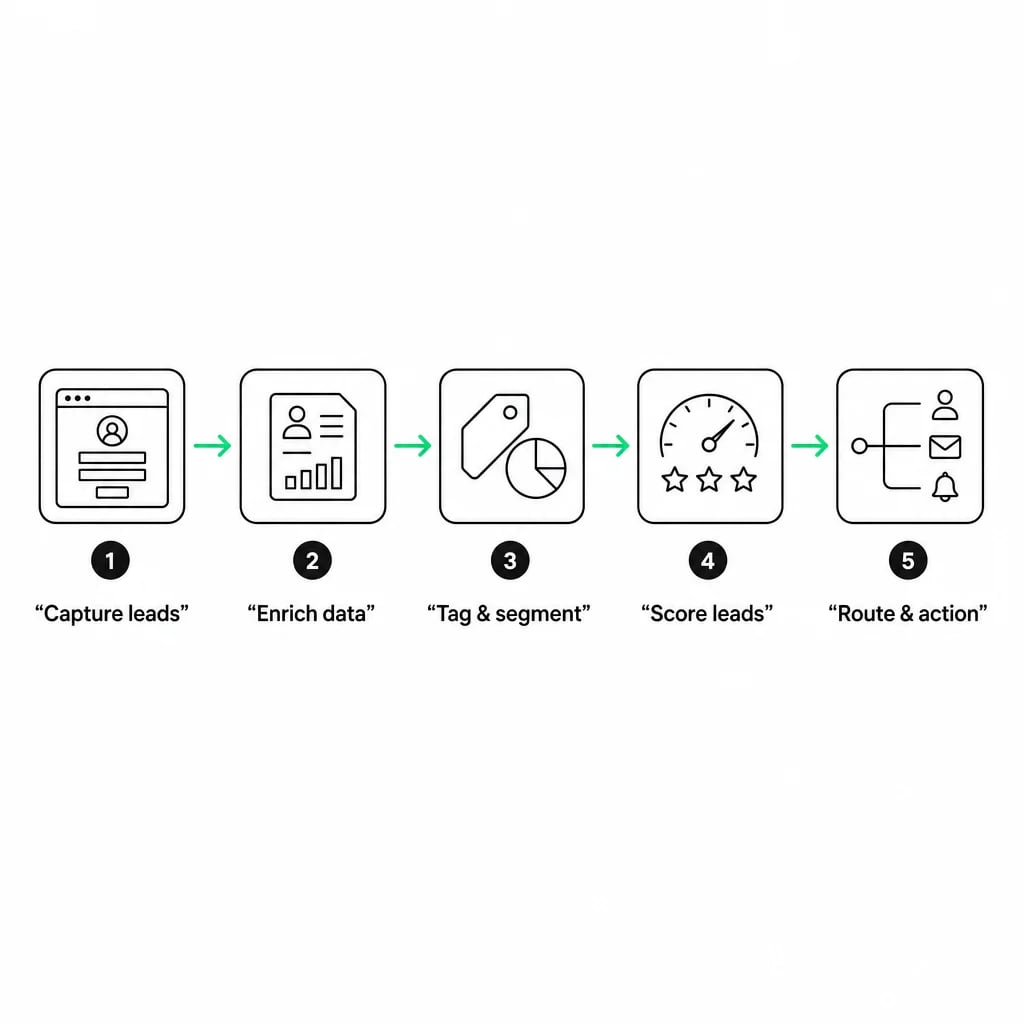
CRM automation lead capture five steps
High-intent leads are routed directly to sales with calendar links or outreach, while low-signal leads enter nurture streams until further engagement justifies escalation Meritto, 2023.
Enrichment data such as decision-maker titles or company size can trigger personalized outreach or re-routing to account executives B2B Rocket, 2024.
What Are the Benefits of Structured Lead Automation?
Implementing structured lead capture and routing significantly reduces lead leakage and cost per acquisition. Multi-site campaigns using content-driven acquisition to feed CRM intake have demonstrated these improvements Huggins and Hansen, 2023.
How Can I Automate Nurture, Follow-Up, and Reporting?
After automating lead capture, extend automation to nurture sequences, follow-up cadences, and reporting. Automated follow-ups are pre-set, timed communications (email, call prompts, SMS) triggered after initial contact to keep prospects engaged and move them through the decision process PlanGrowDo, 2026.
What Are Best Practices for Follow-Up Sequences?
- Start with an immediate thank-you or confirmation within 24–48 hours.
- Follow with value-driven touches at 7-day and 30-day intervals Hazeldine, 2024.
- Adapt sequences based on prospect engagement and preferences.
- Escalate to phone or LinkedIn outreach if email engagement stalls PlanGrowDo, 2026.
Nurture automation often spans multiple channels, using segmentation and intent data to deliver personalized content via email, display ads, and social media Selby, 2025. AI can assist with timing and message personalization, but human oversight ensures authenticity and compliance Campaign Creators, 2025.
Why Is Reporting Automation Important?
You can automate reporting to track key metrics such as lead response time, pipeline conversion, and sales cycle length. Configure dashboards that surface alerts and KPIs for continuous improvement Yuen, 2025.
This reduces manual reporting effort and keeps performance insights front and center to guide decisions BizTech Magazine, 2026.
What Are the Keys to CRM Automation Success in 2026?
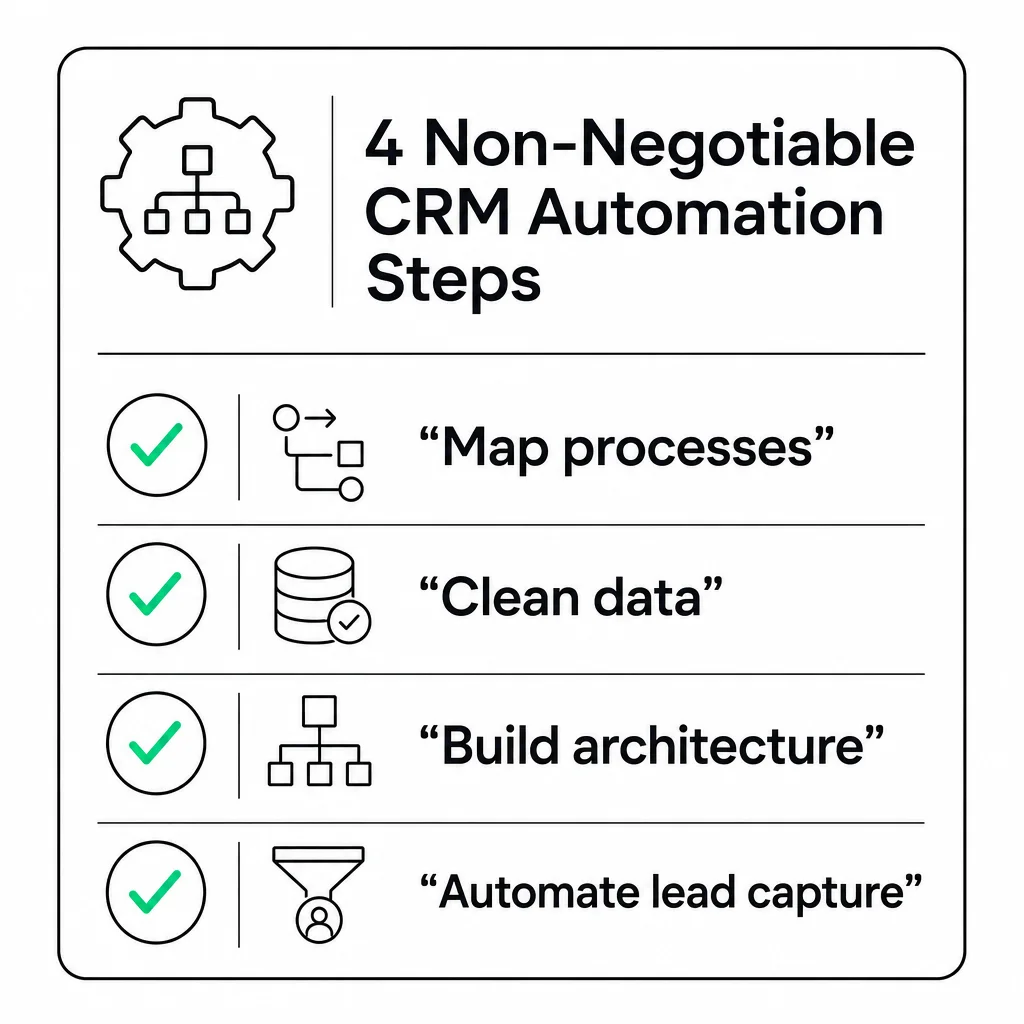
Automating your CRM is not about buying the newest tool or layering AI on broken processes. It starts with discipline: map your processes, clean your data, and build a technical foundation that connects CRM with your entire business.
Begin with high-impact automations like lead capture, scoring, and routing to ensure no opportunity is missed. Follow up with nurture and reporting workflows that keep prospects engaged and your team focused on value-added activities Bangia et al., 2020.
Measure results, pilot changes, and adapt continuously—automation is a journey, not a one-time project Yuen, 2025.
Remember, automation won’t fix poor data quality, unclear processes, or lack of training. The most successful initiatives start with process clarity, prioritize data hygiene, and build cross-team alignment before scaling Casanova et al., 2022.
By following these steps, you’ll unlock CRM automation’s true promise in 2026: faster sales cycles, higher conversion rates, and more time for strategic growth.
| Manual CRM Management (Pre-Automation) | Automated CRM (2026 Approach) |
|---|---|
| High risk of lost leads and slow sales cycles due to manual handoffs and spreadsheet dependencies | Streamlined lead capture, scoring, and routing ensures no leads slip through and speeds up sales cycles |
| Data inconsistencies and duplication are common, leading to reporting errors and poor decision-making | Standardized field names, ownership rules, and automated data flows improve data quality and reporting accuracy |
| Processes are often unclear, with bottlenecks and manual errors slowing down workflows | Mapped, validated processes allow for targeted automation of frequent, rule-based, and error-prone tasks |
| Reporting requires manual effort and is prone to delays or inaccuracies | Automated dashboards and alerts provide real-time insights and reduce manual reporting workload |
| Scaling requires more staff and increases complexity | Automation enables scaling without proportionally increasing team size or complexity |
Frequently Asked Questions
How do I start automating my CRM for the first time?
Begin by mapping your current sales and customer processes in detail, then clean your data by standardizing field names, removing duplicates, and setting clear ownership rules before selecting automation tools.
Why is data hygiene important before CRM automation?
Automation amplifies your existing data quality, so poor data—like duplicates or inconsistent fields—will lead to faster, larger-scale errors and reporting issues if not addressed first.
What technical setup is recommended for scalable CRM automation?
Adopt a hub-and-spoke architecture with your CRM as the central hub, integrate key systems using standardized data models and connectors, and use middleware or integration platforms to manage data flows and errors.
How does automated lead capture and routing work in a modern CRM?
Leads are captured from forms or chat, enriched in the CRM, automatically tagged and scored, then routed instantly to the right sales or nurture path based on their intent and fit.
Is it a myth that automation alone will fix broken sales processes?
Yes, automation will not fix unclear processes or poor data; success starts with process mapping, data hygiene, and cross-team alignment before any tools are implemented.