Artificial intelligence (AI) is reshaping industries and redefining the skills needed for tomorrow’s workforce. As 2026 approaches, the demand for AI experts is growing rapidly. This surge is fueled by advances in agentic systems, AI capable of autonomous decision-making, and multimodal foundation models that process multiple types of data simultaneously Davenport & Bean, 2025. But becoming an AI expert today requires more than coding skills. It means understanding AI’s evolving technologies, the organizational dynamics behind adoption, and how to deliver real business value.
This article offers a clear, step-by-step roadmap to becoming an AI expert in 2026. We’ll cover foundational AI concepts, essential technical skills, how to integrate AI into organizations, and how to measure and govern AI’s impact.
What Core Concepts Should You Master First?
Starting your AI journey means building a solid understanding of what AI really is. At its core, AI simulates human intelligence in machines to perform tasks like speech recognition, decision-making, and pattern detection Institute of Data, 2023.
AI is generally divided into three types:
- Artificial Narrow Intelligence (ANI): Excels at specific tasks, like voice transcription or image recognition, but can’t generalize beyond them.
- Artificial General Intelligence (AGI): Aims to perform any intellectual task a human can.
- Artificial Superintelligence (ASI): Surpasses human intelligence in all domains Escott, 2017.
Today’s practical AI is mostly ANI, focused on specialized applications Smith, 2025.
Understanding machine learning (ML), the subset of AI where systems learn from data, is key. Deep learning, which uses neural networks to handle complex data like images and text, is especially important Institute of Data, 2023.
It’s also critical to grasp the difference between rule-based systems, which follow explicit instructions, and ML-driven systems, which generalize from data to adapt to new situations Escott, 2017.
Key Foundations to Focus On
- Identifying the problem scope and matching it to the right AI approach.
- Evaluating how well AI systems generalize and align with human values.
- Building conceptual clarity before diving into technical skills Institute of Data, 2023.

What Technical Skills Should You Develop?
After mastering AI fundamentals, focus on technical expertise in machine learning and scalable AI system design.
Machine learning involves training models on data to recognize patterns and make predictions. This starts with representing data and extracting relevant features, which shape the model’s hypothesis space and effectiveness Fox & Guestrin, 2016.
Choosing the right model depends on the problem and data type. Popular model families include:
- Linear models
- Kernel methods
- Tree ensembles
- Neural networks Rosenberg, 2017
Optimization techniques like stochastic gradient descent (SGD) and regularization (L1, L2, elastic net) help prevent overfitting and improve generalization Rosenberg, 2017.
Rigorous evaluation using hold-out sets and cross-validation ensures models perform well on new data and guards against pitfalls like dataset shift Rosenberg, 2017.
How to Build Scalable AI Systems
Scalability is essential as data volumes and workloads increase. AI systems must self-adjust through automated tuning, modular design, and distributed training pipelines Hardesty, 2022.
Tools like PyTorch and Ray enable distributed training, helping AI solutions transition from prototypes to production reliably and cost-effectively Grosvenor et al., 2025.
Ongoing monitoring, retraining, and explainability measures maintain trust and compliance, especially in high-stakes applications Rosenberg, 2017.
How Do You Integrate AI into Organizations?
Technical skills alone don’t make an AI expert. Understanding how to embed AI into organizational workflows is critical.
AI adoption depends on cultural, structural, and managerial factors that influence trust and acceptance Sayyadi and Collina, 2023. Leaders who treat AI integration as a continuous capability, building proces rather than a one-time fix—create environments where experimentation and learning thrive.
What Organizational Factors Matter?
- Flatter hierarchies: Empower frontline employees to implement AI decisions faster.
- Knowledge management: Ensure insights flow upward and models improve continuously.
- Psychological safety: Encourage risk-taking and reduce fear of automation Sayyadi and Collina, 2023.
Human-AI collaboration balances automation with oversight. AI agents speed up routine tasks like data preprocessing and administrative work, but humans remain responsible for judgment, ethics, and innovation Glean, 2025.
Best Practices for Human-AI Workflows
- Classify tasks by risk and repeatability.
- Prepare curated datasets for training.
- Orchestrate specialized AI agents.
- Embed human verification at critical decision points Corb et al., 2023.
This ensures AI augments human roles without compromising integrity or trust Morressier, 2023.
How Should You Measure AI’s Impact and Stay Current?
Measuring AI’s real-world impact is a vital skill. It involves tracking how AI influences strategic outcomes through performance signals and forecasting deviations The Strategy Institute, 2024.
This process includes:
- Data collection and analytic modeling.
- Continuous monitoring.
- Implementing governance protocols for accountability The Strategy Institute, 2024.
What Governance and Strategic Choices Matter?
Responsible AI governance covers safety, privacy, explainability, fairness, and accountability Wong, 2025. Organizations must translate these principles into operational controls before scaling AI.
Decisions about AI architecture, such as early vs. late fusion for multimodal systems, and human-in-the-loop controls affect scalability and risk management Lynch, 2025.
Staying informed about evolving model ecosystems, cost structures, and regulations is essential to remain relevant Stanford HAI, 2025.
Tips for Staying Ahead
- Regularly evaluate new AI tools.
- Measure return on investment (ROI).
- Adapt to shifting industry benchmarks Bizzuka, 2025.
What’s the Takeaway for Aspiring AI Experts?
Becoming an AI expert in 2026 requires more than technical know-how. It demands:
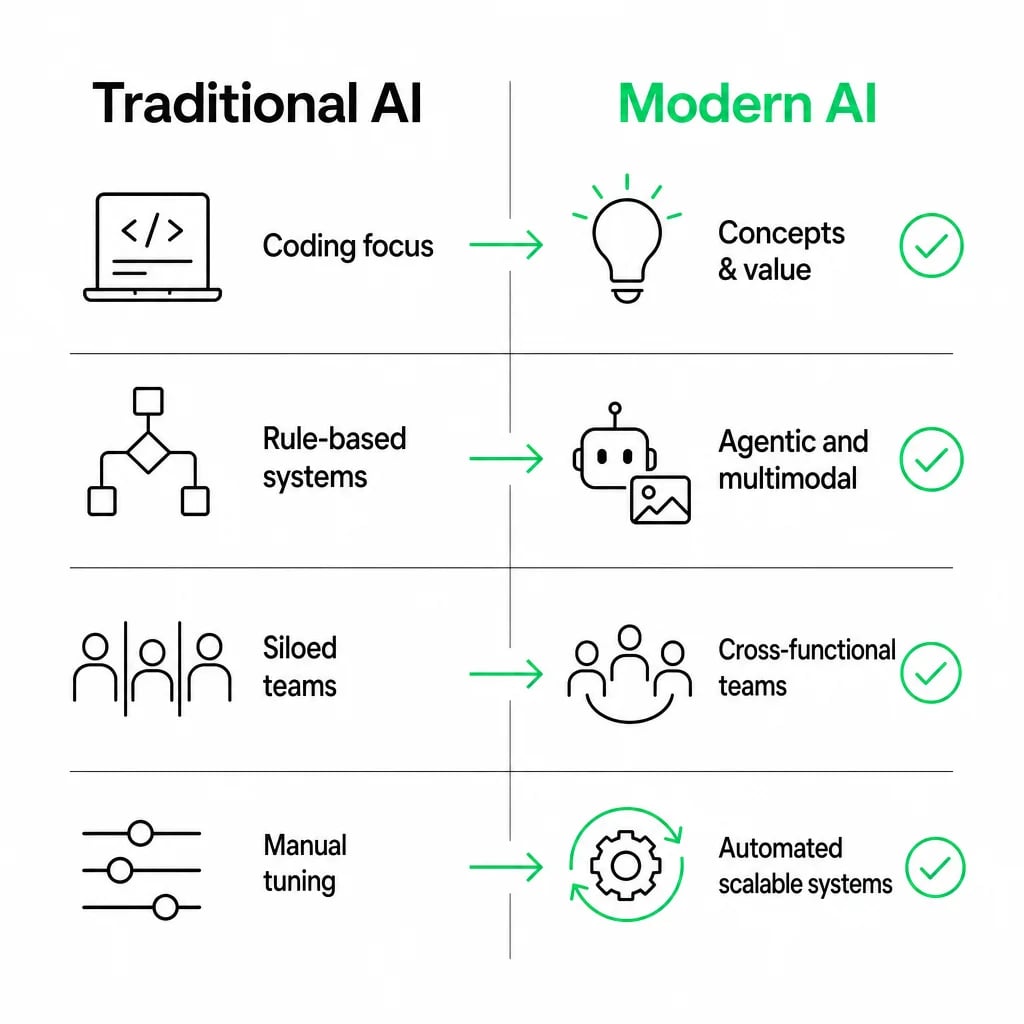
- Deep conceptual understanding of AI types and learning methods.
- Mastery of machine learning and scalable system design.
- Skills to embed AI thoughtfully into organizations.
- Ability to measure impact and govern AI responsibly Davenport & Bean, 2025.
Approach your AI learning as an ongoing journey. Build your foundation, sharpen technical skills, engage with organizational dynamics, and keep updating your expertise as the field evolves Glean, 2025.
By following this roadmap, you’ll position yourself at the forefront of AI innovation, ready to drive meaningful impact in your organization and community. The future of AI is not just about algorithms; it’s about responsible integration, measurable results and the partnership between humans and machines.
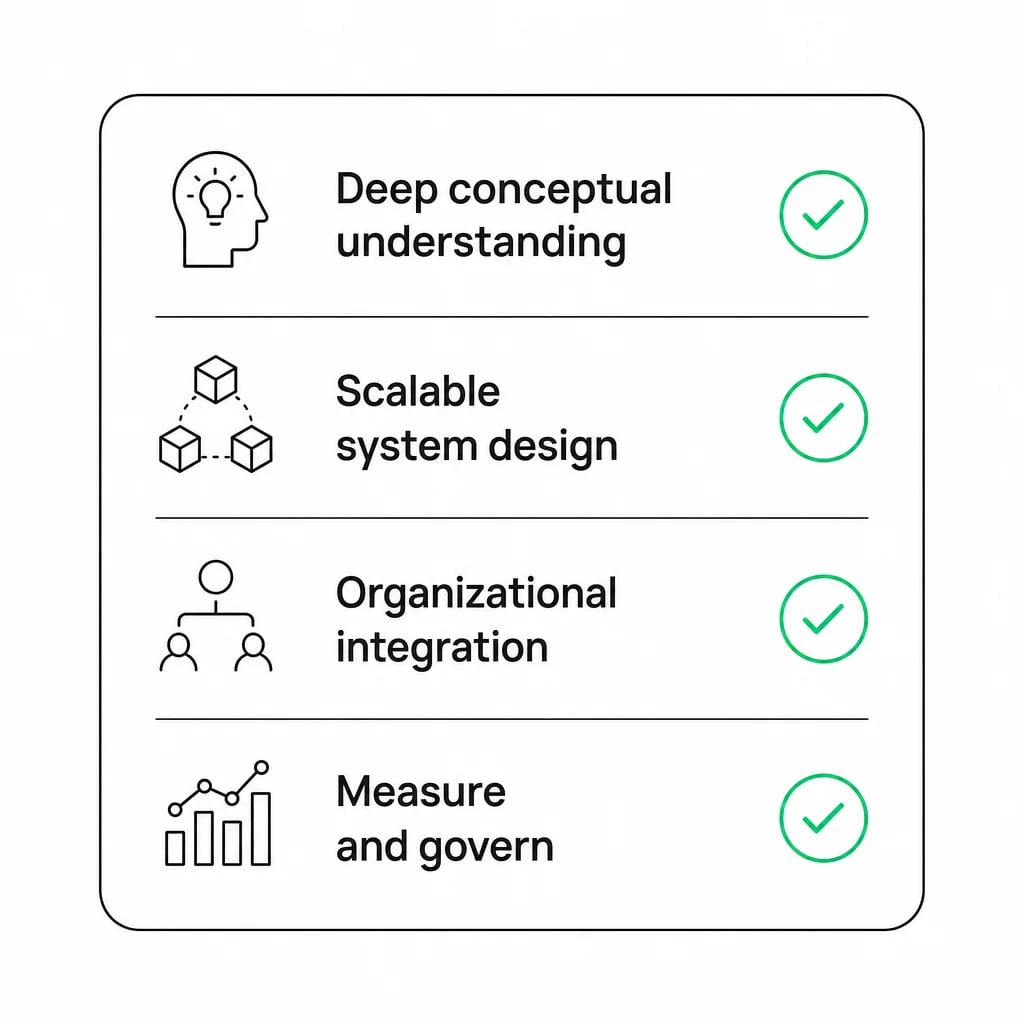
| Traditional AI Expertise (Pre-2026) | Modern AI Expertise (2026 and Beyond) |
|---|---|
| Focused mainly on coding and technical skills | Requires deep understanding of AI concepts, business value, and integration |
| Emphasized rule-based and narrow AI systems | Involves agentic systems and multimodal foundation models |
| Siloed technical teams | Cross-functional collaboration and flatter organizational structures |
| Manual model tuning and deployment | Automated, scalable, and distributed AI systems |
| Limited governance and impact measurement | Strong focus on responsible governance, monitoring, and ROI measurement |
Frequently Asked Questions
What are the first concepts I should learn to become an AI expert?
Start with understanding the basics of artificial intelligence, including the differences between narrow, general, and superintelligent AI, as well as the fundamentals of machine learning and deep learning.
How do I choose the right AI model for my business problem?
Select a model based on the type of problem and data you have—options include linear models, kernel methods, tree ensembles, and neural networks, each suited to different tasks and data structures.
What technical skills are most important for building scalable AI systems?
Key skills include machine learning, data representation, feature extraction, model optimization, and experience with tools like PyTorch and Ray for distributed training and automation.
How can I successfully integrate AI into my organization’s workflow?
Focus on organizational culture, empower employees, ensure knowledge sharing, and embed human verification at critical points to balance automation with oversight.
Is AI only about automation, or does it require ongoing human involvement?
AI is not just about automation—humans are essential for judgment, ethics, innovation, and verifying AI outputs, especially in high-stakes decisions.